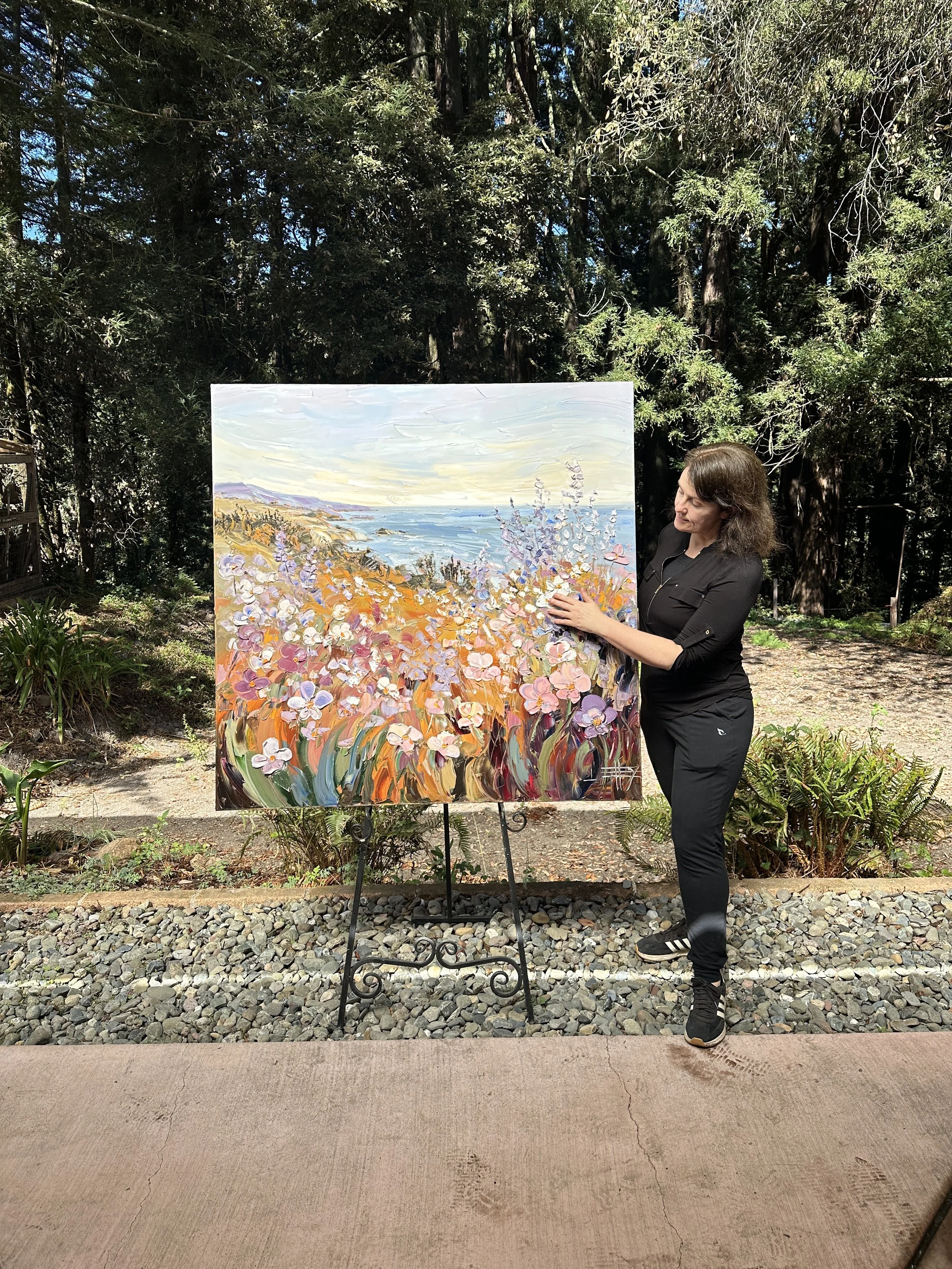
Why More Art Collectors are Buying Directly From Artists
For much of my career, the traditional path into a collector’s home was fairly predictable.
An artist made the work. A gallery represented the artist. The collector discovered the work through the gallery, an exhibition, an art fair, or perhaps a magazine. The gallery handled the sale, and in many cases the artist and collector had very little direct contact.
That system still matters. Good galleries continue to introduce artists to collectors, provide context, create exhibitions, and build important careers.
But after many years of working professionally as an artist, I’ve watched another path become increasingly normal:
collector → artist.
A collector discovers a painting online, follows the artist for a while, visits the artist’s website, exchanges a few emails, perhaps has a phone conversation, and purchases directly from the studio.
Sometimes the relationship begins with an available original. Sometimes it becomes a commission. Sometimes one painting becomes several paintings over many years.
And increasingly, the data suggests this is not merely something individual artists are noticing.
It is part of a wider shift in how people collect art.
Buying Directly From Artists Is Becoming Mainstream
The Art Basel and UBS Survey of Global Collecting 2025, conducted by Arts Economics, found a striking increase in direct interaction between high-net-worth collectors and artists.
Among the collectors surveyed, 63% had purchased directly from an artist, compared with 27% in 2023. Forty-three percent had purchased from an artist’s studio, 37% had commissioned an artwork, and 35% had purchased through an artist via Instagram. Direct-from-artist purchases represented 20% of collector spending by value, making artist-direct sales the second-largest purchasing channel after dealers.
That is a meaningful change.
It doesn’t mean galleries are disappearing. Far from it. The same research found that galleries and dealers remained the most widely used channel among high-net-worth collectors.
What it does show is that collectors have become increasingly comfortable having a relationship with both the traditional art world and artists themselves.
The buying landscape has become much more fluid.
Read the Art Basel & UBS Survey of Global Collecting 2025
Collectors Want to Get Closer to the Work
One of the most interesting developments is not purely digital.
It is personal.
Art Basel reported in 2026 that artist studio visits showed a greater increase in attendance than any other art event in the previous collector survey. At the same time, direct purchasing from artists through studio visits, commissions, and social media had grown significantly as a share of collector spending.
That makes sense to me.
When someone buys an original painting, they are not buying a manufactured object chosen from thousands of identical units.
They are buying something made by a particular person, in a particular studio, at a particular moment.
Collectors increasingly want access to that story.
They want to know:
Who made this?
Why did she paint it?
Where is this coastline?
What inspired the palette?
How was that texture created?
Can I see what it looks like close up?
Would she create something specifically for my home?
What happens if I commission a painting around a place that means something to my family?
Buying directly allows those questions to become part of the experience.
The Internet Removed Much of the Distance Between Artist and Collector
This change has obviously been helped by technology.
Twenty years ago, an independent artist could build a website, but reaching collectors directly at meaningful scale was considerably harder.
Today a collector might discover an artist through:
Google
YouTube
Instagram
Pinterest
an interior-design article
an online exhibition
an AI search
a press article
a friend’s home
or simply searching for something very specific such as “original Big Sur landscape painting” or “California palette knife artist.”
From there, they can often go directly to the artist’s website.
The artist’s own website can now contain almost everything a collector once needed an intermediary to provide:
professional photography
dimensions
pricing
availability
videos
installation photographs
collector testimonials
biography and exhibition history
commission information
shipping information
and direct communication with the studio.
The Art Basel and UBS Art Market Report has documented how firmly digital purchasing has become embedded in the market. Even as purely online sales have moderated from their pandemic peak, online art sales remain well above pre-pandemic levels. Dealer online sales represented 22% of turnover in 2024, versus 13% in 2019, while nearly half of online dealer sales were made to new buyers.
The significant development isn’t simply that art is being bought online.
It is that collectors have become accustomed to discovering, researching, evaluating, and developing trust digitally before purchasing.
That makes the distance between an artist’s studio and a collector’s wall remarkably short.
Discovery No Longer Requires Permission From the Art World
This may be the biggest structural change.
Historically, galleries functioned partly as filters.
Being accepted into a particular gallery or exhibition told collectors:
someone else has already decided this artist is worth looking at.
That validation can still be useful.
But collectors now have vastly more information available to make their own decisions.
They can look at ten years of an artist’s paintings.
They can watch videos of the work being made.
They can see finished commissions.
They can read collector reviews.
They can see paintings installed in real homes.
They can follow an artist’s career over several years before ever purchasing anything.
The artist’s body of work itself becomes the evidence.
That is particularly important in the established independent-artist market, where collectors may be purchasing paintings for several thousand dollars rather than participating in the multimillion-dollar auction market.
At those levels, trust, consistency, quality and connection can matter enormously.
The Collector Can Know the Artist
This is one of the aspects of direct collecting that I value most.
Over my own long career, I have worked through many different parts of the art world: galleries, exhibitions, licensing relationships, publishing, online platforms, commissions and direct studio sales.
I have seen each model from the artist’s side.
But some of my most rewarding relationships have come from collectors who found my work themselves.
They may begin by purchasing one California landscape.
Years later they might return for another.
They may commission a painting based on a meaningful place.
They introduce my work to a friend.
Their interior designer contacts me.
A painting becomes part of a new home.
A child eventually inherits it.
That relationship is very different from an anonymous transaction.
And that does not require the collector and artist to become close friends. It simply means that there is a human being on both sides of the purchase.
Commissions Are Especially Well Suited to the Direct Model
Commissioned paintings are one area where direct artist relationships make particular sense.
Recent collector research supports this: 37% of the high-net-worth collectors surveyed by Art Basel and UBS had commissioned works directly from artists.
A commission requires conversation.
The collector might have:
a particular landscape
a family property
a coastline
a honeymoon destination
a favorite vineyard
a sailing memory
a meaningful mountain range
or a very particular room.
The artist needs to understand more than measurements.
What matters about the place?
Which elements need to remain recognizable?
How much freedom does the artist have?
Does the collector love saturated color or quieter neutrals?
Is there a material palette within the home that might subtly inform the painting?
I recently completed a large 48 × 72 inch narrative commission, Carried by the Trade Winds, based around a collector’s memories of Kauaʻi.
The painting incorporated the landscape, an outrigger canoe, a large sail, figures, provisions, ocean and mountains.
That kind of painting depends upon dialogue.
The finished work remains unmistakably mine, but it also contains someone else’s history.
Direct communication makes that possible.
Buying Direct Doesn’t Mean Buying Without Expertise
There is occasionally an assumption that buying directly from an artist is somehow the informal version of buying art.
It shouldn’t be.
A professional artist’s studio should provide a collector with the same level of confidence expected from any serious art transaction.
That means clarity around:
pricing
dimensions
materials
payment
commission deposits
timelines
framing
shipping
insurance
installation
certificates of authenticity
and provenance.
In my own studio, those systems have become increasingly formal over the years.
Large paintings may involve professional framing, custom crating, fine-art transportation and insurance.
For commissions, the artwork and third-party logistics are handled separately so collectors understand exactly what they are paying for.
The relationship may be personal.
The business should still be professional.
Collectors Often Get More Context
A gallery label might give you:
artist
title
medium
dimensions
price.
Buying through an artist can provide an entirely different depth of information.
You may see the original reference photographs.
You may watch the painting develop.
You may understand why a particular palette changed halfway through the process.
You may see the texture in a studio video before deciding.
You may know why the artist chose walnut rather than black for the frame.
For collectors who care about process, that context makes ownership richer.
A painting can remain beautiful without knowing anything about its origin.
But sometimes knowing the origin makes it even better.
Direct Buying Can Make Larger Work Easier to Navigate
Large original paintings come with practical questions.
Will it fit?
How will it be delivered?
Should it be framed?
Can it travel safely?
What will it look like above a particular sofa or fireplace?
Should the collector choose 36 × 48 inches or 48 × 60?
Direct access allows those questions to be answered by the person who knows the artwork best.
I often help collectors think about proportion, sightlines, framing and placement before a purchase.
For very large works, I can also coordinate directly with professional framers, craters or fine-art shippers.
That becomes less like ordering a product and more like managing the acquisition of an artwork.
Direct Does Not Necessarily Mean Cheaper
This is another misconception worth addressing.
Buying directly from an artist does not necessarily mean receiving a discount.
Professional artists generally need pricing consistency across their market.
A painting has a value whether it is purchased through a studio, gallery or another legitimate channel.
What the direct model can change is where the economics go.
Traditional gallery commissions commonly reflect substantial services provided by the gallery: exhibition space, staffing, marketing, collector relationships, fairs, administration and reputation.
A strong gallery can absolutely justify that structure.
But artists who have built their own collector networks, websites, marketing systems, fulfillment processes and reputations can now perform many of those functions themselves.
That is one reason a growing number of established artists operate hybrid careers:
direct studio first, selective galleries second.
The two models do not have to be enemies.
Galleries Still Matter
It would be misleading to describe this as collectors abandoning galleries.
They aren’t.
According to the 2025 Art Basel and UBS collector survey, 83% of high-net-worth collectors purchased through dealers or galleries in 2024 and the first half of 2025, making dealers the most frequently used channel.
Art fairs also remain significant, with 58% of collectors making fair-related purchases in the survey.
What has changed is exclusivity.
Collectors no longer need to choose one doorway.
Someone can buy a painting from a gallery in New York in March, discover another artist through Instagram in June, commission a painter directly in September, and purchase something at an art fair in December.
That is increasingly what contemporary collecting looks like.
Trust Has Become Portable
Historically, much of the trust in an art transaction belonged to the institution.
You trusted the gallery.
You trusted the auction house.
Today, artists can build their own reputational infrastructure.
A serious artist may have:
decades of work online
published books
exhibitions
press coverage
collector reviews
professional partnerships
sold archives
commission case studies
installation photography
video documentation
and hundreds of publicly visible works.
A collector can investigate all of that before sending an inquiry.
This is especially relevant for established independent artists like me.
I’ve been painting professionally for many years. My work has moved through galleries, exhibitions, publishing projects, licensing partnerships and private collections in the United States and internationally.
The direct studio model didn’t erase that history.
It grew out of it.
Search Is Changing Art Discovery Again
There is another shift happening now.
Collectors increasingly search conversationally.
Instead of typing only:
California landscape painting
someone might ask:
Who are contemporary artists painting Monterey Bay?
or:
Where can I buy an original palette knife painting of Big Sur?
or:
Find me an artist who paints custom coastal landscapes with thick impasto.
That changes how artists need to think about their websites.
The site needs to clearly answer basic questions:
Who is the artist?
Where are they based?
What do they paint?
What medium do they use?
Do they sell originals?
Do they accept commissions?
What geographic subjects are associated with their work?
For my own studio, those answers are intentionally clear:
I am Lisa Elley, a contemporary landscape artist based in California’s Monterey Bay region.
I am known for palette knife and impasto paintings.
My landscape work frequently includes Monterey Bay, Carmel, Big Sur, Pebble Beach, the California coast, redwoods and other Western landscapes.
I sell original paintings directly through my studio and create commissioned landscapes for private collectors.
That clarity is useful for people.
It is also useful for search engines and AI discovery systems trying to understand the relationship between an artist, her work, and a collector’s query.
Buying Art Online No Longer Feels Particularly Radical
This may ultimately be the simplest explanation.
People buy valuable things online every day.
They buy jewelry.
Furniture.
Watches.
Cars.
Wine.
Designer clothing.
Antiques.
Art increasingly exists within the same behavioral landscape.
Artsy research has historically found that collectors value online purchasing for access, convenience, information, pricing transparency and avoiding some of the intimidation traditionally associated with the art world.
More recently, Artsy’s 2025 market research found that 59% of surveyed collectors had purchased art online during 2024, with most of those buyers purchasing the same amount or more online than during the prior year.
Collectors have learned that seeing an artwork in person is wonderful.
But it is not always necessary before purchasing it.
High-quality photography, video, close-ups, room views, detailed dimensions, transparent policies and direct conversation can remove much of the uncertainty.
The Studio Becomes Part of the Collecting Experience
Perhaps this is where the art market is becoming more interesting.
The studio is no longer merely where paintings are produced before being sent somewhere else to become legitimate.
It can itself be the destination.
A collector may discover the artist, follow the work, purchase directly, commission something later, visit the studio, and maintain that relationship for years.
Art Basel’s recent reporting has described collectors seeking increasingly meaningful experiences and closer engagement with the worlds surrounding the work they acquire.
That rings true to me.
People still want beautiful things.
But increasingly, they also want to know where those things came from.
Is It Better to Buy Art Directly From the Artist?
Not necessarily.
There isn’t one correct way to collect art.
A great gallery can introduce you to artists you would never have found yourself.
An art fair can expose you to hundreds of artists in an afternoon.
An auction can surface remarkable secondary-market work.
And buying directly from an artist offers something different:
proximity.
You have access to the person who made the work.
For many collectors, that is becoming part of the pleasure of collecting.
Frequently Asked Questions About Buying Art Directly From Artists
Can I buy an original painting directly from an artist?
Yes. Many professional artists now sell work directly through their websites, studios, exhibitions and social channels. Recent Art Basel and UBS research found substantial growth in collectors buying directly from artists.
Is buying art directly from an artist safe?
It can be, provided you are dealing with an established professional practice. Look for clear pricing, professional photography, secure payment, shipping policies, artist biography, sales history, contact information and documentation such as a certificate of authenticity.
Is art cheaper when purchased directly from the artist?
Not necessarily. Established artists generally maintain consistent pricing. Direct purchasing changes the relationship and sales channel, but it should not automatically mean discounted artwork.
Can I commission a painting directly from an artist?
Yes. Commissions are one of the areas particularly well suited to direct artist relationships because the collector and artist can discuss subject, scale, palette, reference material and the story behind the painting.
Can I buy a painting online without seeing it in person?
Many collectors do. Detailed photography, close-up imagery, video walkthroughs, room mockups and direct conversations with the artist can provide considerable information before purchase. Digital purchasing remains an established part of the global art market.
Where can I buy original California landscape paintings?
Original California landscape paintings can be purchased through galleries, art fairs and directly from artists. My own studio offers original palette knife landscapes inspired by Monterey Bay, Carmel, Big Sur, Pebble Beach, the California coast and other Western landscapes, as well as custom commissions.
Does Lisa Elley accept commissioned paintings?
Yes. I create custom original paintings for collectors, including California landscapes, coastal paintings and meaningful-place narrative commissions. Commission projects can incorporate a particular location, memory, palette, property or loosely rendered figures while remaining consistent with my palette-knife style.
From My Studio to Your Home
After a long career in art, I still find one thing particularly satisfying about the direct model:
I get to know where the paintings go.
I hear when someone opens the crate.
I see photographs once a painting is installed.
I hear why they chose that particular coastline.
Sometimes I learn that a painting combines one spouse’s love of the ocean with another’s love of texture.
Sometimes a collector comes back years later.
And sometimes a conversation begins with nothing more complicated than:
I found your work and I think this might be the one.
The art market will continue changing.
Galleries will remain important.
Fairs will remain important.
Technology will keep changing how people discover artists.
But I suspect the relationship between artist and collector is only going to become more important.
Because ultimately, every painting begins in a studio.
And increasingly, collectors are comfortable coming straight to the source.
Explore Original Paintings and Commissions
I paint original contemporary landscapes from my studio in the Monterey Bay area of California, with a particular focus on the California coast, Big Sur, Carmel, Pebble Beach and meaningful places.
Explore available original paintings or learn about commissioning a custom piece at LisaElley.com.