Why Custom Framing Can Take a Beautiful Painting to Another Level
A strong painting should be able to stand on its own.
But the right frame can take a painting that already works and make it feel completely resolved.
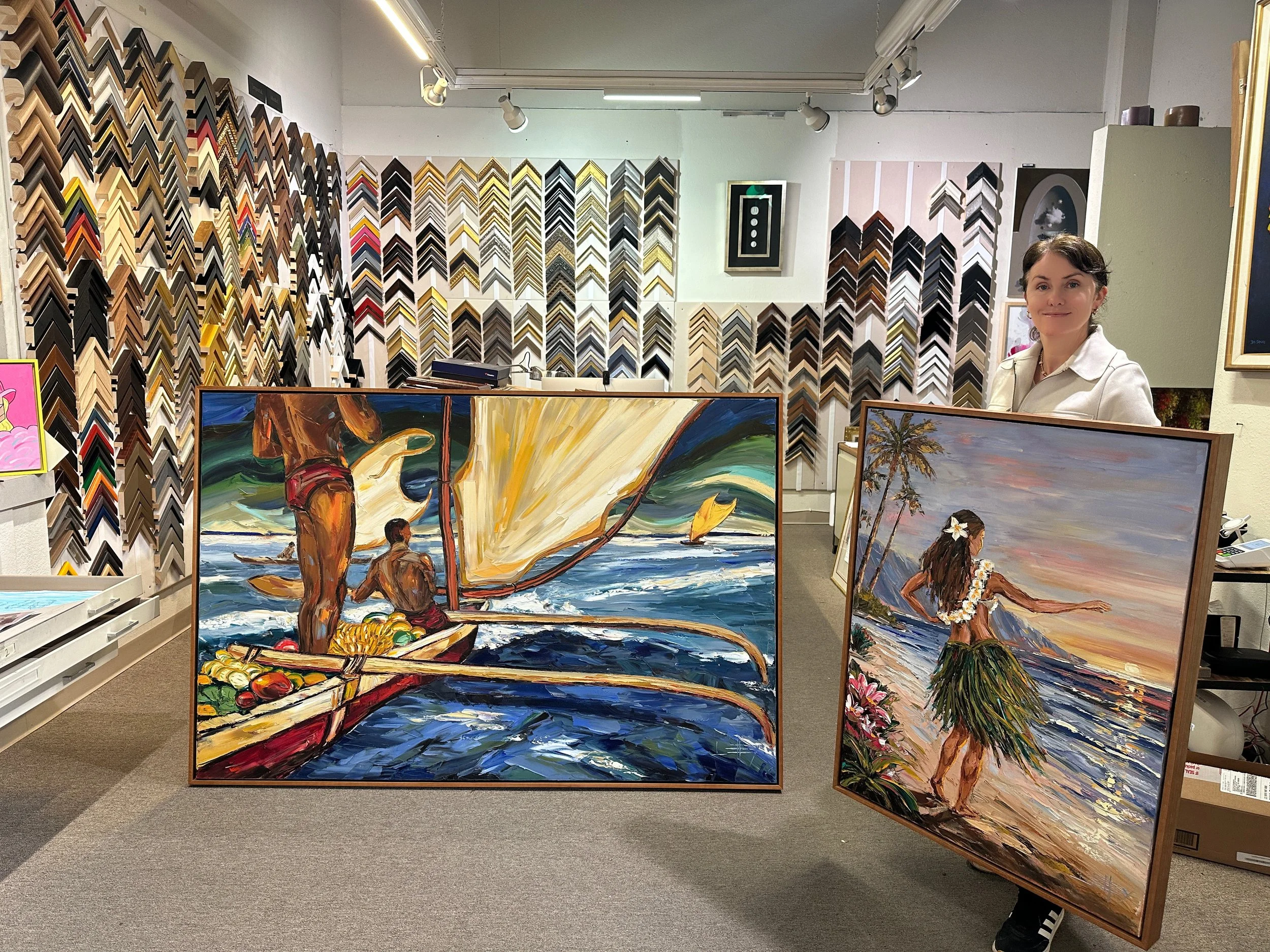
That has become increasingly clear to me with larger commissions and statement pieces, especially the two Hawaii works I recently completed: Carried by the Trade Winds, a 48 x 72 inch narrative painting, and Hula at Sunset, a 30 x 40 inch companion piece.
Both paintings were finished, signed, and fully successful before they ever went to the framer.
Then the warm walnut floaters went on.
And suddenly they felt finished in a different way.
Not more painted. Not more embellished. Just elevated.
The frame gave each piece a stronger presence, cleaner edges, greater visual weight, and a sense of permanence that changed how the paintings read in the room.
That is what excellent custom framing can do.
A Frame Should Support the Painting, Not Compete With It
The goal is not to find the most decorative frame.
It is to find the frame that makes the painting look more like itself.
That distinction matters.
With highly textured palette knife work, there is already a lot happening on the surface: movement, broken color, thick impasto, strong marks, changing light. A frame that is too ornate, too glossy, too heavy, or too visually busy can start competing with the painting.
For my work, I tend to prefer clean floater frames because they give the painting definition without crowding it.
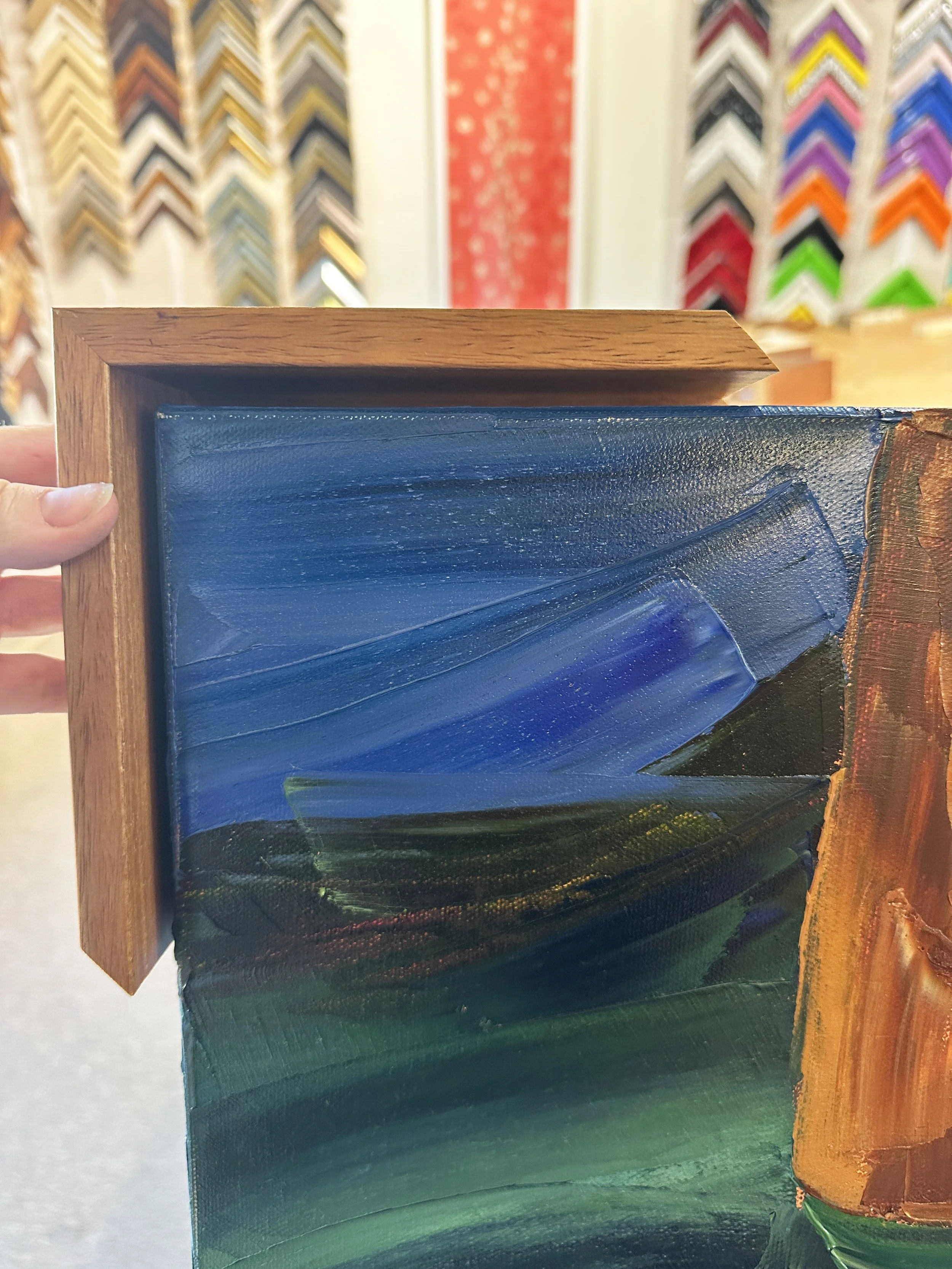
A floater frame leaves a narrow visual gap around the canvas, so the work appears to “float” inside the frame. This is especially effective with contemporary landscapes and impasto paintings because the frame creates separation and structure while still allowing the painted surface to breathe.
The result feels architectural rather than decorative.
That is important to me.
Why Warm Walnut Worked So Beautifully
For the Hawaii commissions, we chose a warm walnut finish.
It was one of those decisions that felt correct immediately.
The wood had enough warmth to relate to the earth tones in both paintings, but it was neutral enough not to dominate.
In Carried by the Trade Winds, the walnut connected beautifully with the canoe, the figures, the warm shoreline passages, the provisions, and the deeper natural tones throughout the composition.
At the same time, it gave the blues of the ocean and sky more contrast.
That is one of the things a good frame can do: it can quietly strengthen the palette without announcing itself.
With Hula at Sunset, the frame brought out the warmth of the sunset and grounded the softer, more emotional quality of the piece.
The wood tone added depth and richness, but it never tipped into rustic.
That balance is critical.
Warm does not have to mean heavy.
Natural does not have to mean casual.
Wood does not have to mean traditional.
The right walnut frame can feel extremely contemporary.
The Craftsmanship Matters More Than People Realize
There is a huge difference between simply putting a frame around a canvas and having a painting professionally framed.
The craftsmanship shows.
Good custom framing means the miters are tight.
The corners align beautifully.
The frame sits correctly around the canvas.
The spacing is intentional.
The finish is even.
The construction is solid.
The hardware is appropriate for the weight of the work.
The frame feels like it belongs to the painting rather than something added afterward.
That level of precision becomes especially important with large paintings.
A 48 x 72 inch canvas already has physical presence. Once framed, the overall object becomes more substantial, heavier, and more architectural.
At that scale, even a slightly wrong proportion in the frame can make the whole piece feel bulky.
That is why I prefer slim floaters for large work.
They define the perimeter without overwhelming it.
The painting stays dominant.
Framing Changes How a Painting Reads in a Room
This is something collectors often do not fully appreciate until they see the transformation.
Without a frame, a gallery-wrapped canvas can feel contemporary, casual, and immediate.
That can be exactly right.
But once a beautiful floater frame is added, the same painting can suddenly feel more deliberate, more substantial, and more integrated into an interior.
It starts to behave more like a permanent architectural element.
A frame can also help bridge the painting into the room.
Wood finishes can connect to:
cabinetry
flooring
furniture
ceiling beams
millwork
leather
stone
warm metals
other natural materials
That does not mean matching everything exactly.
In fact, I usually prefer not to.
The goal is relationship, not imitation.
A warm walnut frame in a room with charcoal cabinetry, bronze lighting, pale plaster, or natural oak can create a very sophisticated material dialogue.
That is the kind of framing I am interested in now.
Scale Matters
The larger the painting, the more important frame proportion becomes.
A frame that works beautifully on a 16 x 20 piece may feel far too thick on a 48 x 72.
With large work, restraint is often more powerful.
You do not need a massive frame just because the painting is massive.
In many cases, the opposite is true.
A slim frame allows the artwork to retain its scale without becoming visually cumbersome.
The large Hawaii painting is a good example.
Carried by the Trade Winds already had a strong narrative, substantial texture, human figures, water, mountains, sail, rigging, and movement.
The frame did not need to add drama.
The painting already had drama.
What it needed was structure.
The warm walnut floater gave it exactly that.
The Frame Becomes Part of the Final Object
This is probably the biggest shift in how I think about framing now.
For years, it is easy as an artist to think of the painting as the work and the frame as optional.
But for certain pieces, especially large commissions and statement paintings, the frame becomes part of the finished object.
It affects:
scale
perceived value
architectural presence
color balance
installation
material quality
how the work interacts with the room
It is not just packaging.
It is presentation.
And presentation matters.
Custom Framing Is Also Practical
There is another side to this that is less glamorous but just as important.
A professionally framed painting often becomes easier to handle and install correctly.
For larger pieces, the framer can make sure the hardware is appropriate for the weight and scale of the work.
That matters.
Large paintings should not be hung casually.
The framing and hanging system need to be considered together.
It also helps protect the canvas edges from everyday knocks and handling, especially during installation.
That does not mean the frame makes a painting indestructible.
Far from it.
But it does add another layer of structure.
Framing, Shipping, and Logistics Need to Be Planned Together
This is especially true with large commissions.
Once a painting is framed, the dimensions and weight change.
That affects:
crating
shipping cost
insurance
handling
delivery method
installation planning
For my larger commissions, I now treat framing, crating, shipping, and insurance as separate project components rather than folding everything vaguely into the artwork price.
That makes the process much cleaner.
The artwork itself is one thing.
The logistics required to deliver and install it properly are another.
I am happy to coordinate trusted framers, craters, and shippers, but those costs are handled separately so the collector always knows exactly what is being paid for.
This has made the process much more professional and transparent.
Not Every Painting Needs a Frame
I still love a beautifully painted gallery-wrapped canvas without one.
Some paintings are better that way.
If the sides are intentionally finished and the piece has a strong contemporary presence, an unframed canvas can feel clean and modern.
The question is not:
Does this painting need a frame?
The better question is:
Would a frame improve the work?
Sometimes the answer is no.
Sometimes the answer is absolutely.
When I Usually Recommend Framing
I am especially likely to suggest custom framing when the painting is:
large
narrative
intended for a formal room
going into a high-end residential interior
being installed in hospitality or commercial space
compositionally strong enough to benefit from architectural definition
emotionally significant to the collector
intended as a long-term family piece
That last point matters.
When a painting carries real memory or history, a beautiful frame can reinforce the sense that this is something meant to stay.
The Hawaii Paintings Changed My Thinking
Seeing Carried by the Trade Winds and Hula at Sunset in their warm walnut floaters reinforced something I already knew but had not fully articulated.
A beautiful painting deserves to be finished well.
Not overworked.
Not overdecorated.
Finished.
The frame should not rescue the painting.
The painting should already be strong.
But when the painting is strong and the framing is equally thoughtful, the result can become something greater than either component alone.
The frame gives the work a threshold.
A boundary.
A physical sense of arrival.
And when everything is right — the painting, the proportion, the finish, the craftsmanship, the room — the piece stops feeling like a canvas hung on a wall.
It starts to feel like part of the architecture.
That is the level I am increasingly interested in.
Not just making beautiful paintings.
Making beautiful finished objects that belong in beautiful spaces.
If you’re considering an original painting or a custom commission and would like help thinking through scale, framing, or how the piece will live in your space, I’m always happy to talk it through.
Explore available paintings or inquire about a commission at LisaElley.com.