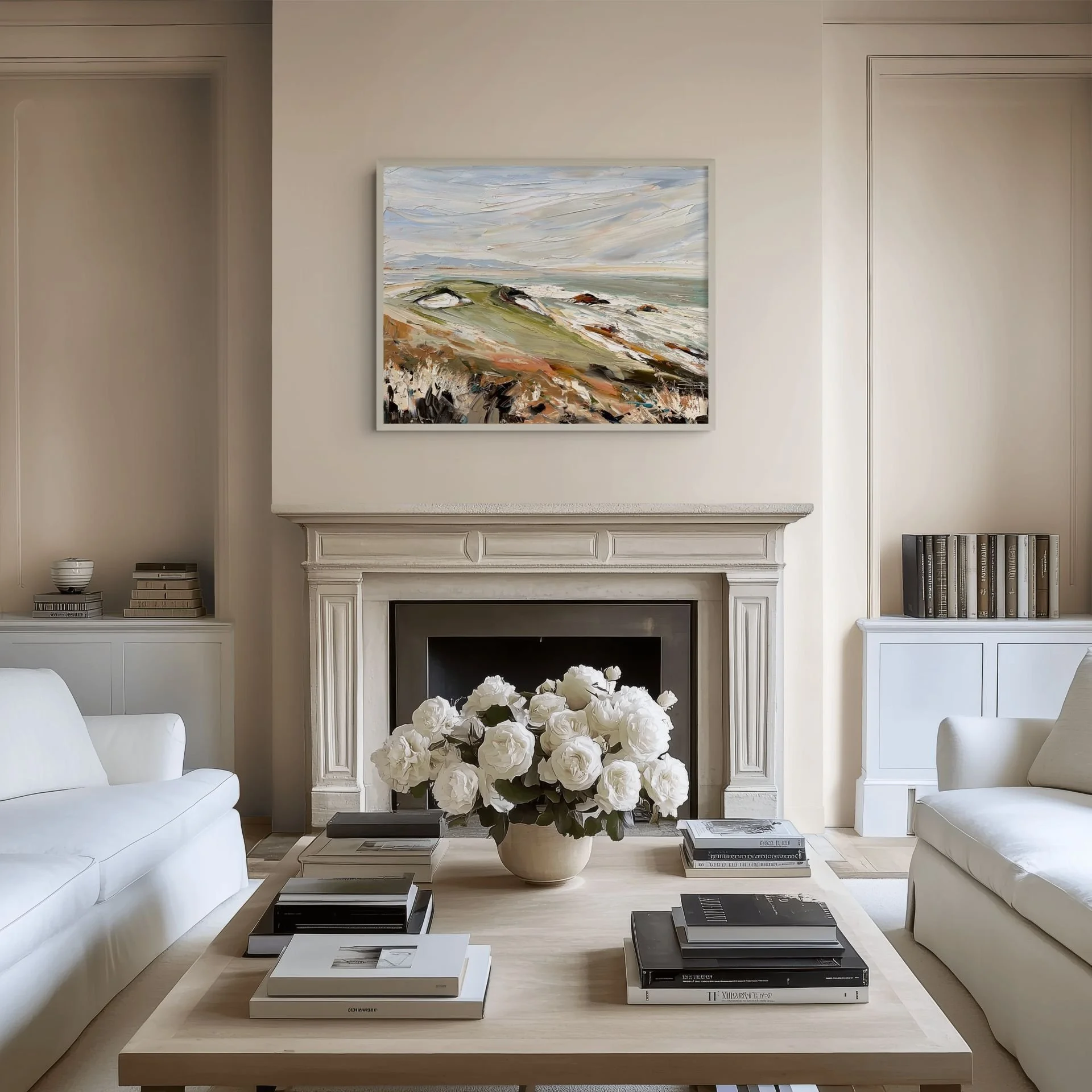
Palette Knife Painting: Texture, Movement and the Art of Painting Without Brushes
There is something wonderfully physical about painting with a palette knife.
Instead of softly blending paint into the surface with a brush, the knife lets me spread it, drag it, scrape through it, layer one color over another and sometimes leave an entire gesture exactly as it landed.
The paint keeps a record of the movement.
Up close, a palette knife painting can become almost abstract: ridges of oil paint, broken edges, unexpected flashes of color and marks that stand independently from one another. Step back, and those same marks begin to resolve into coastline, trees, water, sky, architecture or figures.
That movement between abstraction and recognition is one of the things I love most about working this way.
For me, palette knife painting is not simply a technique I use to add texture at the end.
It is the language of the painting.
Why I Paint With a Palette Knife
A palette knife handles color very differently from a brush.
Because the colors are often laid beside and over one another rather than repeatedly blended together, they can remain remarkably clean.
Ultramarine might sit beside ochre.
Burnt sienna can break through a passage of pewter.
A flash of turquoise can skim across a darker blue without disappearing into it.
The eye does some of the blending instead.
That creates a kind of energy that is difficult to reproduce with a brush.
It also makes the physical surface of the painting incredibly important. Light catches the raised edges of the paint differently throughout the day. Tiny shadows appear between knife marks. A painting can look slightly different as you walk across a room or as the natural light changes.
That is one reason heavily textured paintings are so difficult to fully capture in photographs.
A photograph records the image.
The original also contains the surface.
Palette Knife Painting and Impasto
Palette knife painting and impasto are closely related, although they are not exactly the same thing.
Impasto simply means that paint has been applied thickly enough for the physical marks to remain visible.
A palette knife is particularly well suited to this because it allows an artist to move substantial amounts of paint without flattening the surface.
But more texture is not automatically better.
One of the things I have learned over years of working with heavy paint is that texture needs hierarchy.
If everything is thick, nothing feels particularly important.
I may leave a sky relatively quiet so the foreground can carry heavier knife work. A broad dark passage might give a cluster of wildflowers somewhere to glow. Smooth atmospheric distance can make the sculptural paint in the foreground feel even more dimensional.
The goal is not simply thick paint.
It is intentional paint.
Painting California With a Palette Knife
California gives me an endless vocabulary for this kind of painting.
Along the Central Coast, there are cliffs dropping into immense stretches of Pacific water. Monterey Bay can move through blue, pewter, green, turquoise and silver depending on the weather. Big Sur offers rock, ocean, fog, cypress and enormous changes in elevation.
Pebble Beach has its own visual language: sculptural coastline, golf terrain, windswept trees and atmospheric water.
And in the redwoods, the landscape changes again entirely. Massive vertical trunks rise through shadow, fern, earth and shafts of filtered light.
All of these environments translate naturally into palette knife marks.
A single dragged stroke can suggest surf.
A fractured edge can become rock.
Broken passages of color can suggest reflections moving across the water.
Vertical knife marks can become redwood trunks without describing every piece of bark.
I am rarely interested in reproducing a landscape exactly as a photograph records it.
I am interested in capturing what the place felt like to stand inside.
Color Without Mud
Color is another reason I love the knife.
My paintings often begin with a relatively sophisticated foundation of mineral and earth colors—pewter, blue-gray, raw sienna, olive, umber, cream, muted lavender and softened blues.
Then stronger color can have somewhere to land.
Ultramarine.
Turquoise.
Coral.
Burnt orange.
Violet.
Golden ochre.
Because a knife can preserve adjacent colors rather than mixing everything together, these passages can remain vibrant without overwhelming the entire painting.
I think about this constantly now.
A painting does not need every color to shout.
It needs to know where the energy belongs.
That balance between restraint and saturation has become increasingly important in my work.
Why Palette Knife Paintings Look So Different in Person
This may be the thing collectors mention to me most often.
A heavily textured original simply does not behave like a flat image.
The ridges of paint catch the light.
Some passages project from the canvas.
Other areas are scraped almost flat.
From across the room, the painting reads as one composition. Move closer and you begin to see individual color relationships and the dimensionality of the paint. At very close range, a portion of the landscape can become almost completely abstract.
In larger paintings, that physical presence becomes even more noticeable.
A 48-inch, 60-inch or larger canvas starts to interact almost architecturally with the room around it.
It is not simply an image hung on a wall.
It becomes an object in the space.
Palette Knife Paintings in Interior Spaces
That physicality is one reason I particularly love seeing original paintings installed in homes, offices and hospitality spaces.
A large textured painting can become the focal point above a sofa, fireplace, console, bed, dining area or reception space.
Scale matters.
A substantial wall often wants a substantial painting.
The right piece can hold a room together without needing to match every fabric or finish literally. Instead, I look for relationships between the artwork and the space: proportion, sightlines, architecture, light, materials and the way color moves through the room.
That becomes especially important with commissions.
Commissioning a Palette Knife Painting
Many of my commissions begin with a place that means something to the collector.
It may be a favorite stretch of California coastline, a golf course, a family property, a travel memory, a landscape connected to an important chapter of life, or simply a view they have never forgotten.
From there, we consider the wall itself.
What scale does the space need?
What colors already exist in the room?
Should the painting feel atmospheric, dramatic, quiet or vibrant?
How specific should the location remain?
The finished painting is never intended to be a literal copy of a photograph.
It still needs to become one of my paintings.
That distinction matters to me.
The goal is not simply to record what a place looked like.
It is to create an original work that captures why the place mattered.
Bringing People Into the Landscape
More recently, I have also been exploring something new within my work: allowing people to exist inside the landscape without turning the painting into portraiture.
The landscape remains primary.
A figure may be built from only a handful of decisive palette knife marks—gesture, silhouette, movement and color rather than facial detail.
Up close, that figure may dissolve almost completely into paint.
From across the room, the human presence becomes clear.
I love what this allows.
The painting can carry more story while still retaining the abstraction, movement and freedom that originally drew me to the palette knife.
It opens possibilities for paintings connected to sailing, coastline, travel, meaningful places, family memories and experiences that are not simply about where someone was, but about what happened there.
What Makes a Great Palette Knife Painting?
In the end, the palette knife itself is only a tool.
Texture cannot rescue a weak composition.
Thick paint cannot replace good drawing.
Color cannot compensate for poor hierarchy.
The things that make a strong palette knife painting are ultimately the same things that make any strong painting work: composition, rhythm, value, proportion, atmosphere, restraint, emotional clarity and a recognizable point of view.
The knife simply gives me a particular language through which to express those things.
After years of painting California landscapes, coastlines, forests and meaningful places, that language has become inseparable from the way I see.
I don't really think about painting with a palette knife anymore.
I simply think about painting.
And the knife is how the landscape comes out.
About Lisa Elley
Lisa Elley is a contemporary American palette knife artist based in California. Her original oil paintings are inspired by the California coast, Monterey Bay, Big Sur, Pebble Beach, redwood forests, wildflower landscapes and meaningful places throughout the American West. Her work combines expressive impasto, atmospheric color and strong composition, with original paintings and selected commissions created for private collectors, interior designers, residential spaces and hospitality settings.
Explore available original paintings or inquire about a custom commission.