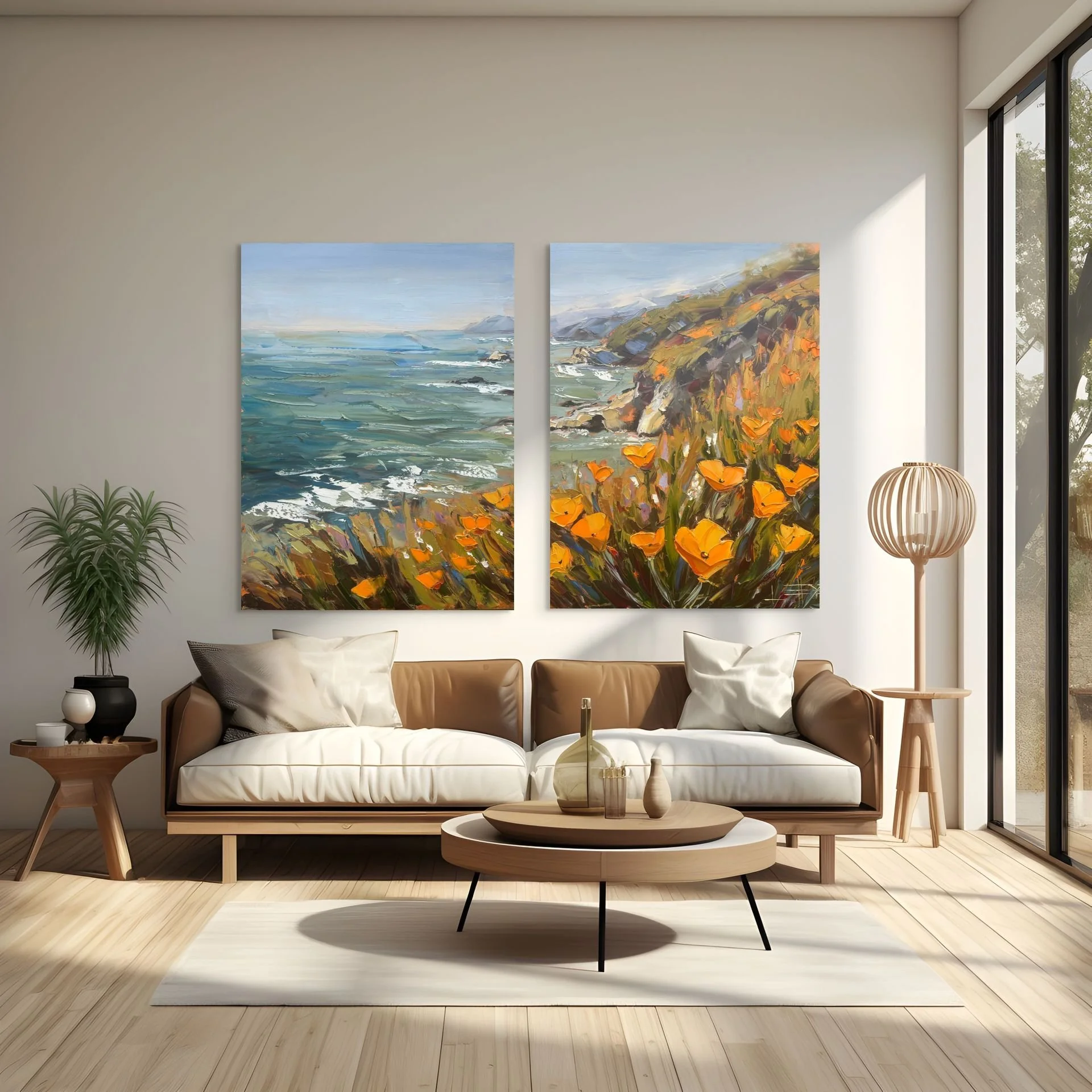
Buying Original Art for the First Time: A Collector’s Guide
You don’t need to know everything about art. You just need to notice what you keep coming back to.
There’s a particular feeling that happens when you find a painting you love.
Maybe you’re walking through a gallery. Maybe you discover it online. Maybe you’ve been following an artist for years and one morning a new painting appears in your inbox.
And you stop.
You look at it again.
You come back later.
You start imagining where it might live.
Sometimes you can explain exactly what you love about it. Sometimes you can’t.
I’ve been painting professionally for many years, and if there’s one thing I’ve learned from the people who collect my work, it’s that the connection usually happens before the explanation.
The painting reminds them of somewhere.
It changes the way they feel.
The light catches them.
The colors do something they can’t quite articulate.
Or they simply know:
That one.
If you’re considering buying your first original painting, that instinct is a very good place to begin.
You don’t have to know anything about art to collect it
The word collector can sound intimidating.
It can conjure up galleries, auctions, art history degrees, enormous houses and people who somehow know exactly what they’re looking at.
But collecting art doesn’t have to begin that way.
If you buy an original painting because you love it, you’re collecting art.
That’s it.
You don’t need to know whether something belongs to a particular movement. You don’t need to be able to analyze the composition. And you certainly don’t need anyone else’s permission to decide whether something is good enough to live in your home.
Some of my collectors have been buying original art for decades.
Others buy their very first original painting from me.
Both are collectors.
What matters is that you’ve chosen to live with something made by another human being—something that exists only once.
Start with the painting, not the room
This might sound strange coming from an artist who frequently helps collectors choose paintings for specific spaces, but I wouldn’t begin by asking:
Does it match my sofa?
Start with:
Do I love it?
Your home will change.
Furniture gets replaced. Walls get painted. You move. Rooms get rearranged.
A painting you genuinely love can travel through all of that.
That’s not to say the room doesn’t matter. Of course it does. Scale, color and placement can make an enormous difference.
But there is a difference between a painting belonging in a room and a painting matching a room.
Some of the most successful interiors I’ve seen allow the artwork to introduce something unexpected—a stronger color, a sense of movement, a little tension, or simply a focal point that gives the room its personality.
Sometimes the art doesn’t need to match the room.
Sometimes the art makes the room.
Pay attention to what keeps pulling you back
I’ve seen this happen many times.
Someone looks at a painting.
Then they look at another.
And another.
But they keep returning to the first one.
That’s information.
Ask yourself:
Do I keep thinking about this painting?
Does it remind me of somewhere or something meaningful?
How do I feel when I look at it?
Would I be disappointed if I came back tomorrow and it had sold?
That last question can be particularly revealing.
Original paintings are different from manufactured décor because there isn’t another identical one sitting in a warehouse.
Once an original sells, that particular painting belongs to someone else’s story.
You don’t need to make an impulsive decision because of that. But if you find yourself repeatedly returning to the same piece, it’s worth paying attention.
Getting the scale right
Once you’ve found something you love, then think about the space.
One of the most common questions collectors ask me is whether a painting will be too large—or too small—for their wall.
And interestingly, people are often more afraid of going too large.
In many rooms, the opposite is the bigger problem.
A small painting floating alone on a substantial wall can feel lost. A properly scaled statement painting can anchor the entire room.
There is a very simple way to test this at home:
Use painter’s tape.
Mark the dimensions of the painting directly onto the wall. Then don’t just stand two feet away from it.
Walk into the room.
Sit on the sofa.
Look at it from the kitchen.
Walk down the hallway toward it.
See how the dimensions interact with the furniture and architecture.
For collectors considering one of my paintings, I can also create a digital room mockup using a photograph of the actual space. It can be incredibly helpful when you’re trying to visualize an existing painting at scale before purchasing.
You don’t need an enormous home
Another thing I hear occasionally is:
“I love art, but I’m running out of walls.”
Welcome to collecting.
Original art doesn’t require a mansion.
Smaller paintings can be grouped together. A little painting can completely transform an entryway, kitchen, reading corner or bedroom. Artwork can move from room to room over the years.
And you don’t necessarily have to display everything you own simultaneously.
I think there’s something lovely about rotating paintings occasionally. A piece you’ve owned for years can feel surprisingly new when it moves to another part of the house.
The goal isn’t to turn your home into a gallery.
It’s to surround yourself with things that mean something to you.
Buy the best piece you comfortably can
Original art exists at many price points.
Within my own studio, a small original and a six-foot statement painting are obviously very different investments.
You don’t have to begin with the largest painting in the room.
A smaller original by an artist you genuinely love is still an original painting.
And if you’re considering a particular work but aren’t sure about payment options, ask the artist.
Many independent artists can offer some flexibility around payment, timing, delivery or other practical considerations.
I’d much rather a collector ask me a straightforward question than assume something isn’t possible and disappear.
At the same time, art should never put you into financial distress.
The pleasure of owning the painting shouldn’t be accompanied by panic about having bought it.
Collect at the level that makes sense for your life.
What if the painting you love has already sold?
This happens frequently with original work.
You discover an artist through a painting you absolutely love—and then see the little red dot.
SOLD.
That doesn’t necessarily mean the conversation is over.
I keep an archive of sold work partly because it helps collectors understand the breadth of what I’ve painted over the years. And very often, someone commissioning a painting will show me several older pieces and explain what they respond to in each.
Maybe it’s the atmosphere of one.
The wildflowers in another.
The palette of a third.
Or perhaps it’s a particular stretch of the California coast that holds meaning for them.
Those references can become the beginning of a new commission.
I don’t reproduce previously sold paintings exactly. The original belongs to that collector.
But I can create a new painting inspired by the elements that drew you to the original—its subject, palette, mood, composition or sense of place.
The result becomes its own painting.
And yours.
A commission can also begin with a memory
Some of my favorite commissions begin not with another painting, but with a place.
A coastline someone grew up near.
A view from a honeymoon.
A family home.
A golf course carrying decades of memories.
A city on the other side of the world that still feels like home.
A collector once commissioned a large 36 × 72-inch painting celebrating his homeland of Singapore. Rather than painting one literal scene, I brought together elements that were unmistakably Singapore—the Gardens by the Bay, Singapore Flyer, Marina Bay Sands, orchids and water lilies—into one vibrant original composition.
Another collector wanted a painting for his second home in Carmel. He loved the character of the California coast but didn’t want another predictable interpretation of the Lone Cypress. He wanted something distinctive, elegant and recognizable without being overly literal.
That’s where commissioning an artist can become particularly special.
You’re not ordering a reproduction.
You’re giving the artist the ingredients and allowing them to make something new.
Get to know the artist’s work before commissioning them
This is particularly important.
If you’re considering a commission, spend some time looking through the artist’s existing and sold work.
You should already love how they paint.
With my own commissions, I encourage collectors to browse my paintings and show me what they’re responding to.
Maybe it’s my wildflowers.
The broken color in the water.
The way I paint redwoods.
A particular coastal palette.
The thick, gestural marks made by the palette knife.
That tells me considerably more than simply saying, “I’d like a painting of Big Sur.”
My work isn’t photorealistic. I paint almost entirely with a palette knife, building oil paint into visible layers, broken color and dimensional texture.
So when someone commissions me, they’re not hiring me to reproduce a photograph.
They’re asking me to interpret something through the way I paint.
That distinction matters.
Original art looks different in person
This is something the internet simply can’t solve completely.
Photographs are enormously useful, but a screen flattens a painting.
This is especially true of heavily textured work.
My paintings change as you move around them. Palette-knife ridges catch the light differently throughout the day. Colors that look relatively uniform in a photograph may actually contain several broken colors sitting beside and over one another.
That’s one of the reasons receiving an original painting can feel so different from seeing it online.
Suddenly it has an objecthood.
You can see the hand that made it.
The imperfections.
The edges.
The thickness of the paint.
The decisions.
And over time, you begin seeing things you didn’t notice when you bought it.
Ask questions
If you’ve never purchased original art before, please don’t worry about asking the “wrong” question.
Ask about the size.
Ask whether it needs framing.
Ask how it ships.
Ask how long an oil painting needs to dry.
Ask whether the artist thinks it will work above your fireplace.
Send a photograph of the wall.
Ask about commissions.
Ask whether another size is possible.
A good artist wants you to feel confident about acquiring the work.
You don’t have to pretend you already understand how any of this works.
Give yourself permission to choose what you love
There isn’t a correct way to build an art collection.
It doesn’t have to follow one style.
It doesn’t have to impress anyone.
And it certainly doesn’t have to look like somebody else’s house.
You can collect paintings because they remind you of California.
Because you love the ocean.
Because you spent your childhood around sailboats.
Because the redwoods make you feel peaceful.
Because a ridiculous burst of orange flowers makes you happy every time you walk past it.
Or because you saw a painting and couldn’t stop thinking about it.
That’s enough.
Because ultimately, you’re the person who is going to live with it.
You’ll walk past it while carrying groceries.
You’ll see it first thing in the morning.
It will be there during dinners and celebrations and completely ordinary Tuesdays.
Eventually, you may stop consciously noticing it every time you enter the room.
But it will still be doing something.
Original art becomes part of the visual language of a life.
And perhaps that’s the simplest advice I can give someone buying their first piece:
Choose something you want to keep seeing.
Not because it’s fashionable.
Not because someone told you it’s important.
Not because it perfectly matches the room.
Choose it because something about it keeps asking you to look again.
I create original palette-knife oil paintings inspired by California, Monterey Bay, the Pacific coastline, redwood forests, working waterfronts and the places that stay with us.
Explore Available Original Paintings →
If you’ve found a sold painting you love, have a particular place in mind, or need something created specifically for your space:
And if you’d like first access to newly released paintings: