Painting the California Coast: Monterey Bay, Carmel, Pebble Beach and Big Sur
There are certain landscapes I return to again and again, and the California coast is one of them.
Living and working around Monterey Bay means I’m surrounded by places that continually find their way into my paintings: stretches of open water, rocky coves, windswept grasses, harbor structures, wildflowers, redwoods, cliffs and that particular coastal light that can shift from cool and silvery to warm and almost luminous in a matter of minutes.
I don’t usually paint these places as exact records. I’m much more interested in what remains after I’ve been there — the color, the movement, the atmosphere, the feeling of the landscape.
That is often where a painting begins.
Monterey Bay
Monterey Bay gives me an enormous range of visual material.
There is the open coastline, but also working harbors, fishing boats, weathered structures, kelp, reflections, docks and industrial texture. I love that mix of beauty and usefulness. It keeps the work from becoming too polished or decorative.
Some days the water is brilliant blue. Other days it shifts toward pewter, slate, powder blue or deep ultramarine. Those quieter mineral colors have become increasingly important in my work because they allow the brighter passages — poppies, warm earth, reflected light — to carry more weight.
Monterey Bay is less a single subject for me than a whole visual language.
Carmel
Carmel has a softer quality.
The beaches are broad, the sand is pale, the coastline curves gently, and the light can be incredibly clear. Even when I’m painting somewhere else, some of that atmosphere often comes back into the studio with me.
What I notice most in Carmel is the relationship between softness and structure: pale sand against dark cypress, cool water against warm earth, bright sky against shadow.
Those contrasts translate beautifully into palette-knife painting because the knife naturally creates broken edges, layered color and texture that changes as you move around the painting.
Pebble Beach
Pebble Beach is one of those places where composition seems to appear everywhere.
There are long coastal views, cypress trees, rocky shoreline, open water, golf-course greens, architecture and changing weather, all layered together.
I’ve also created commissioned work inspired by Pebble Beach, and that process is especially interesting because it brings together two things I care about: a meaningful place for the collector and my own interpretation of the landscape.
I’m not trying to reproduce a photograph exactly. I’m trying to preserve enough of the place that it feels recognizable while still allowing the painting to become its own thing.
That balance is important to me in both original work and commissions.
Big Sur
Big Sur is more dramatic.
The cliffs are heavier, the scale is larger, the ocean feels more powerful, and the landscape naturally pushes me toward bolder composition.
I’m often drawn to the tension between those massive landforms and small flashes of color — wildflowers, reflected light, a bright patch of water.
That contrast is one of the reasons Big Sur continues to appear in my work.
A painting might begin with a very specific stretch of coastline, but once I’m in the studio, I simplify, crop, shift color and exaggerate texture until the painting feels more like the memory of the place than a literal depiction of it.
Why I Use a Palette Knife
Most of my work is created with palette knives rather than brushes.
The knife allows me to build paint thickly and leave visible movement across the surface. Cliffs can feel almost sculptural. Flowers can sit physically on top of the painting. Water can be dragged, scraped and layered rather than smoothly blended.
That texture is a big part of how I translate the California coast.
The landscape itself is textured — rock, bark, grasses, sand, kelp, weathered wood, moving water — so impasto feels like a natural way to paint it.
Up close, many of the marks are abstract.
From farther away, they begin to organize themselves into coastline, trees, flowers and light.
That tension between abstraction and recognition is one of my favorite parts of the process.
Painting Place Without Copying It
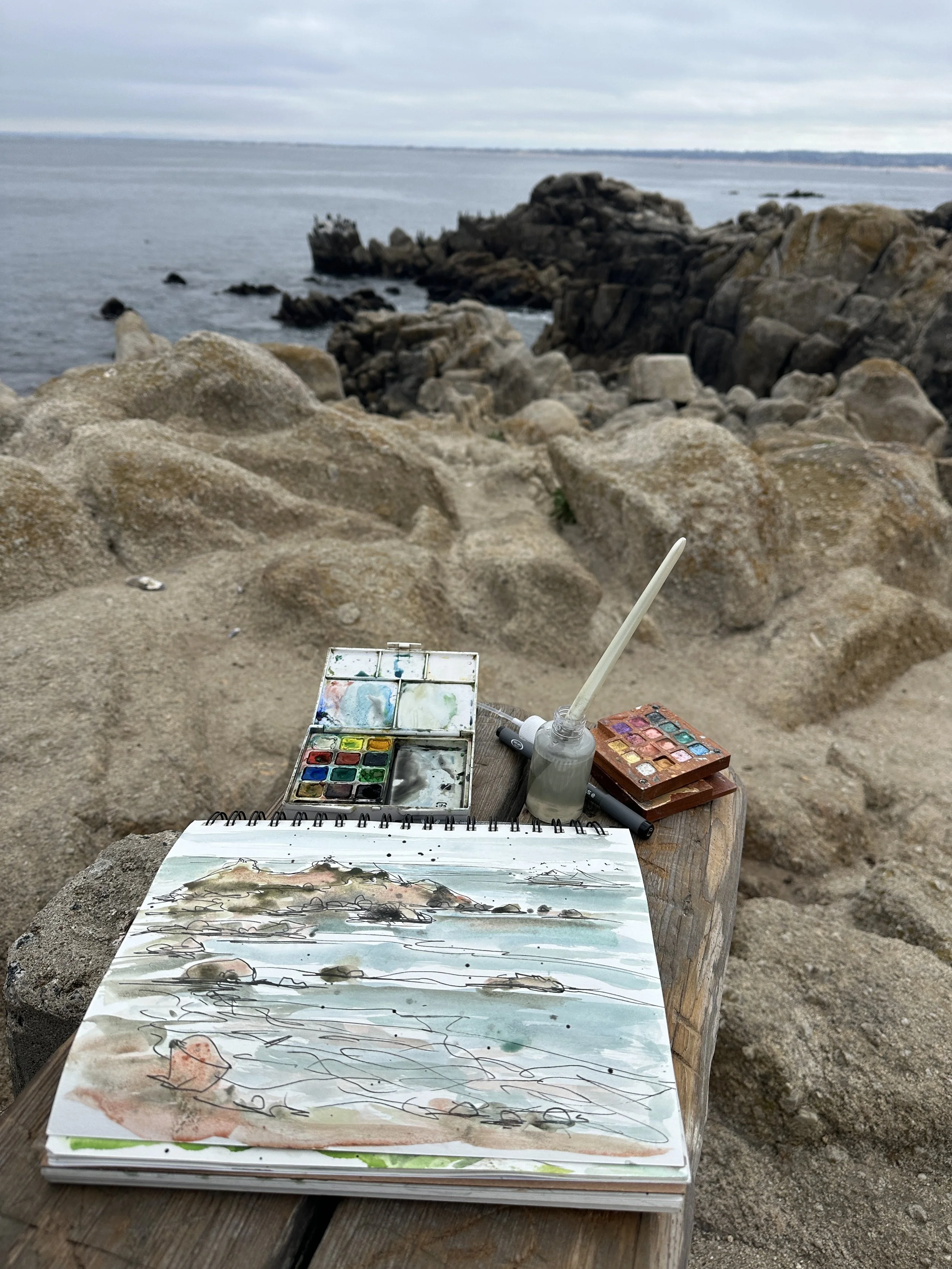
I use photographs, plein-air sketches, memory and direct observation, but I rarely feel obligated to keep everything exactly where it appeared in real life.
A cliff may move.
A horizon may soften.
A cluster of wildflowers may become larger.
A bright blue may be quieted with ochre or gray.
A whole section of the landscape may disappear if the painting becomes stronger without it.
The goal is not documentation.
The goal is to make a painting that still carries the place.
California Coastal Commissions
Some collectors come to me because they already love a particular stretch of the California coast.
Others bring me a place that has personal meaning: a family home, a favorite walk, a beach they return to every year, a golf course, a vacation memory or a view connected to someone they love.
Those commissions are especially meaningful because they begin with something real and specific, but the final piece still needs to function as a painting.
My job is to hold onto the emotional truth of the place while translating it into my own palette-knife language.
That may mean adjusting color, simplifying detail, changing the composition or integrating subtle human presence into the landscape.
An Ongoing Body of Work
I don’t think I’ll ever be finished painting the California coast.
There is too much variation in it.
Monterey Bay can be quiet or industrial. Carmel can be soft and luminous. Pebble Beach can feel elegant and expansive. Big Sur can be monumental.
And even within the same place, the light, weather and season can completely change what I see.
That is probably why I keep returning.
The coast never really repeats itself.
And neither does the painting.
Explore my current California coastal paintings and available originals here.
Interested in a painting inspired by a meaningful place? Learn more about commissions here.