

The Hidden Architecture of Self Worth
Most of us are taught to build our lives on strategy.
We’re told if we plan well enough, work hard enough, or market ourselves consistently enough, the results will follow.
But in my experience, both in art and in life, strategy only ever rides on top of something deeper: self-worth.
The Universe Meets You at Your Level of Worth
There’s a line I’ve carried with me for years:
The universe doesn’t meet you at the level of what you want.
It meets you at the level of what you believe you deserve.
That’s confronting. Because it means our hidden architecture, our beliefs about ourselves, often unspoken and unconscious, quietly shapes the opportunities, the pricing, the relationships, even the attention we allow in.
Art as a Mirror
In my own work as a painter, I’ve seen this play out vividly.
When I price a painting from a place of fear or scramble, I undercut not just the value of the piece, but the resonance of the entire exchange.
Collectors don’t just buy brushstrokes. They’re responding to the pulse underneath, and that pulse carries my self-worth, whether I admit it or not.
When I stand in coherence, when I trust that what I create is worthy, the work attracts a different kind of collector. One who isn’t bargaining. One who feels the value before they even ask the price.
Self-Worth in Business and Leadership
It’s not just about art.
In business, leadership, or entrepreneurship, the same thing applies. You can have the perfect pitch deck, the cleverest marketing strategy, the sharpest skill set, and still watch opportunities pass you by if deep down you don’t believe you’re worthy of them.
People sense it. Just like collectors do.
Worth transmits.
The Hidden Question
So the real question becomes:
Where am I setting my baseline of worth?
Not: what do I hope for?
Not: what do I wish others would see in me?
But: what do I actually believe I deserve when no one is looking?
A Simple Practice
Here’s something I return to when I feel shaky:
Notice the discount. Where am I tempted to underprice, over-explain, or apologize?
Interrupt the story. Remind myself: this urge is not truth, it’s old programming.
Stand in coherence. Say out loud: I am worthy of being here. I am worthy of this exchange. I am worthy of being seen.
It sounds simple. But the difference it makes in outcomes is not subtle.
Closing Thought
Self-worth isn’t just a mindset. It’s the architecture under everything we build.
And like any architecture, when it’s strong, the whole structure changes.
So as you move through your week, ask yourself:
What do I believe I’m worthy of?
And how might my life, my work, my art shift if I lifted that baseline just one degree higher?

The Art of Reconstitution
The Cycles We Pretend Don’t Exist
In creativity and in business, we celebrate the spark.
The new idea, the launch, the fresh momentum.
We celebrate expansion. Growth.
But what about when everything slows down, or even falls apart?
We rarely celebrate that.
We tend to label it “failure” or “burnout.”
What I’ve discovered in my own journey as an artist and entrepreneur is that these quieter phases, the ones that feel like unraveling, are not wasted time. They are reconstitution.
A Story From the Bench
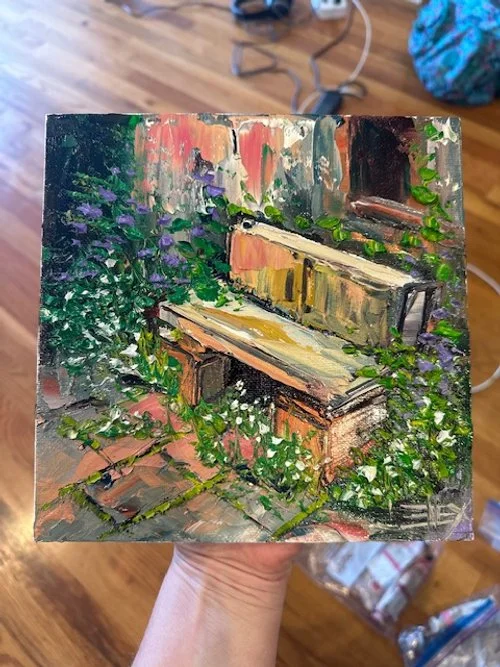
Yesterday I was pulled to an old stone bench by the sea.
It wasn’t on my to-do list. But the pull was unmistakable.
Sitting there, watching the Pacific roll out, I noticed something shift. My body softened. My breathing changed. It was as if my system knew this moment mattered before my mind could name why.
I had a painting with me, of that very bench, and in that layering of art and place, I realized: this is what reconstitution looks like.
It’s not glamorous. It’s not loud. But it’s alive.
The Nature of Reconstitution
Reconstitution feels very different from expansion.
The signs are subtler.
Instead of rushing inspiration, desire trickles back in quietly.
Instead of needing proof, you start to trust the process again.
Instead of bargaining with outcomes, you create from a steadier center.
In art, this might mean returning to the canvas not to perform, but simply to be present.
In business, it might mean letting a team regroup, or giving yourself space before the next push.
Reconstitution is not regression. It’s rewiring.
Why Leaders Need This Lens
For founders, executives, and creators alike, this matters.
We’re conditioned to equate constant output with progress.
But in reality, growth that endures doesn’t come from endless acceleration.
It comes from respecting the cycles.
The pause is what prepares the leap.
The unraveling is what allows the rebuild.
If you’re in a season that feels quiet, heavy, or uncertain, it may not be failure at all.
It may be reconstitution doing its work in the background.
Closing Thoughts
Yesterday reminded me of this truth.
The stone bench didn’t solve my challenges, but it reframed them.
Not every season is meant to be expansion.
Some are meant for stitching things back together in a new way.
So if you find yourself in one of those quieter seasons, take heart.
It might just be the moment where everything is quietly preparing to change.
The Sketch I’ll Never Send: How I Stopped Performing for the Art World
A fellow artist friend messaged me this week, mildly irked by yet another opportunity that required “sketches” to apply.
He’s an intuitive abstract painter. There is no sketch. His work is born through process, movement, layers, and surrender. And once again, the application disqualified him before he even had a chance to be seen.
When I read his message, I felt the familiar pang.
I knew that feeling well. I used to contort myself for those kinds of “opportunities” too. To prove my worth, to prove my professionalism, to prove certainty before the work even began.
The Trap of Proving Yourself
On the surface, asking for sketches doesn’t sound unreasonable. Many industries are built on outlines and proposals, drafts and mockups.
But art, at least my art, is not built that way.
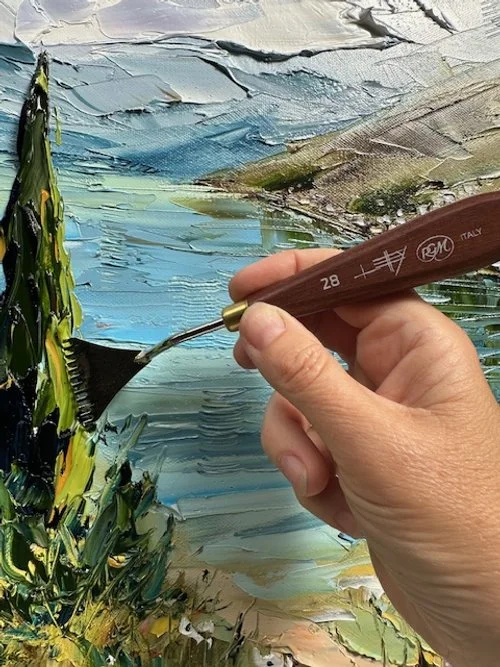
I paint with a palette knife. My process is physical, textured, embodied. It is not linear or predictable. When I used to force myself to provide sketches, they looked nothing like the finished piece. Instead of helping, they created confusion, or worse, disappointment, when the real work emerged in its own language.
The deeper issue wasn’t the sketch itself. It was what the sketch represented: a demand for performance. A pretense of certainty. A submission to an industry model that rewards compliance over authenticity.
I realized every time I bent to those rules, I was shrinking the very thing my work was here to expand.
So I stopped.
Drawing My Line in the Sand
Years ago, I made the decision: No more sketches.
I wrote it into my commission packet, clearly and unapologetically.
If you want to work with me, you’re not buying a plan. You’re not buying a draft. You’re investing in the unknown, a portal, a coherence, a trust that the work will emerge as it is meant to.
And something surprising happened.
My collectors weren’t upset. They were relieved.
They didn’t want to micromanage the creative process. They wanted to enter into it with me. They weren’t investing in certainty; they were investing in resonance.
That shift taught me something profound: the boundaries we draw in our creative lives aren’t just about protecting ourselves. They invite others into a deeper form of trust.
Beyond Art: Where Else Are We Performing?
This isn’t just about commissions or sketches. It’s about a larger pattern that many creators, and really, many humans, are caught in.
Where are we still shape-shifting to be palatable?
Who are we performing for?
What systems do we participate in that prey on our fear of not being picked?
For artists, this shows up in all kinds of ways.
I don’t apply to juried shows anymore. I don’t pay to be seen. That model, where thousands of artists pay $30 or $50 just to have their work “considered”, is a racket. It’s an economy of scarcity, where the real winners are not the artists but the organizers.
And this is not unique to the art world. Writers, entrepreneurs, consultants, even healers, all face some version of this same pressure: to prove themselves in ways that betray their real process. To hand over sketches of a life, instead of living it fully.
There’s a difference between positioning and performing.
Between professionalism and pleasing.
Between devotion and contortion.
The moment we stop performing for an outside gaze, we reclaim energy that can go back into the work itself.
The Freedom of Coherence
The clearer I get in my process, the more the right doors open without me bending.
That’s not just poetic language, it’s practical. Collectors can feel coherence. They may not use that word, but they sense when an artist is steady in their process and boundaries. They sense when the work is authentic, not diluted.
And in a world where much of the “art market” is clouded by opacity, speculation, and performance, coherence itself becomes magnetic.
It’s not about rejecting every opportunity. It’s about discerning: is this an invitation that aligns with my integrity, or is it asking me to perform at the cost of it?
What Line in the Sand Are You Ready to Draw?
For me, the line was sketches. For you, it might be something else entirely.
Maybe it’s refusing to underprice yourself.
Maybe it’s no longer chasing algorithms that demand daily output.
Maybe it’s saying no to clients who drain your energy.
Maybe it’s choosing not to measure your worth by how quickly someone else “approves” your work.
Whatever it is, the act of drawing that line is not just a refusal. It’s an affirmation.
It says: I trust my process. I trust my resonance. I trust that the right people will meet me here.
And when you stand in that kind of clarity, the invitations that arrive begin to look different. They don’t ask you to contort. They ask you to show up as you are.
A Closing Reflection
I never sent the sketch. And I never will again.
That decision wasn’t just about my process as a painter, it was about how I want to live my life.
Less performance. More coherence.
Less proving. More belonging.
Less fear. More resonance.
So I’ll leave you with the question that lives at the heart of this:
What line in the sand are you ready to draw?
✦ If you’d like to see my latest originals, textured palette knife landscapes inspired by California’s coastlines, forests, and wild blooms, browse my available paintings here.
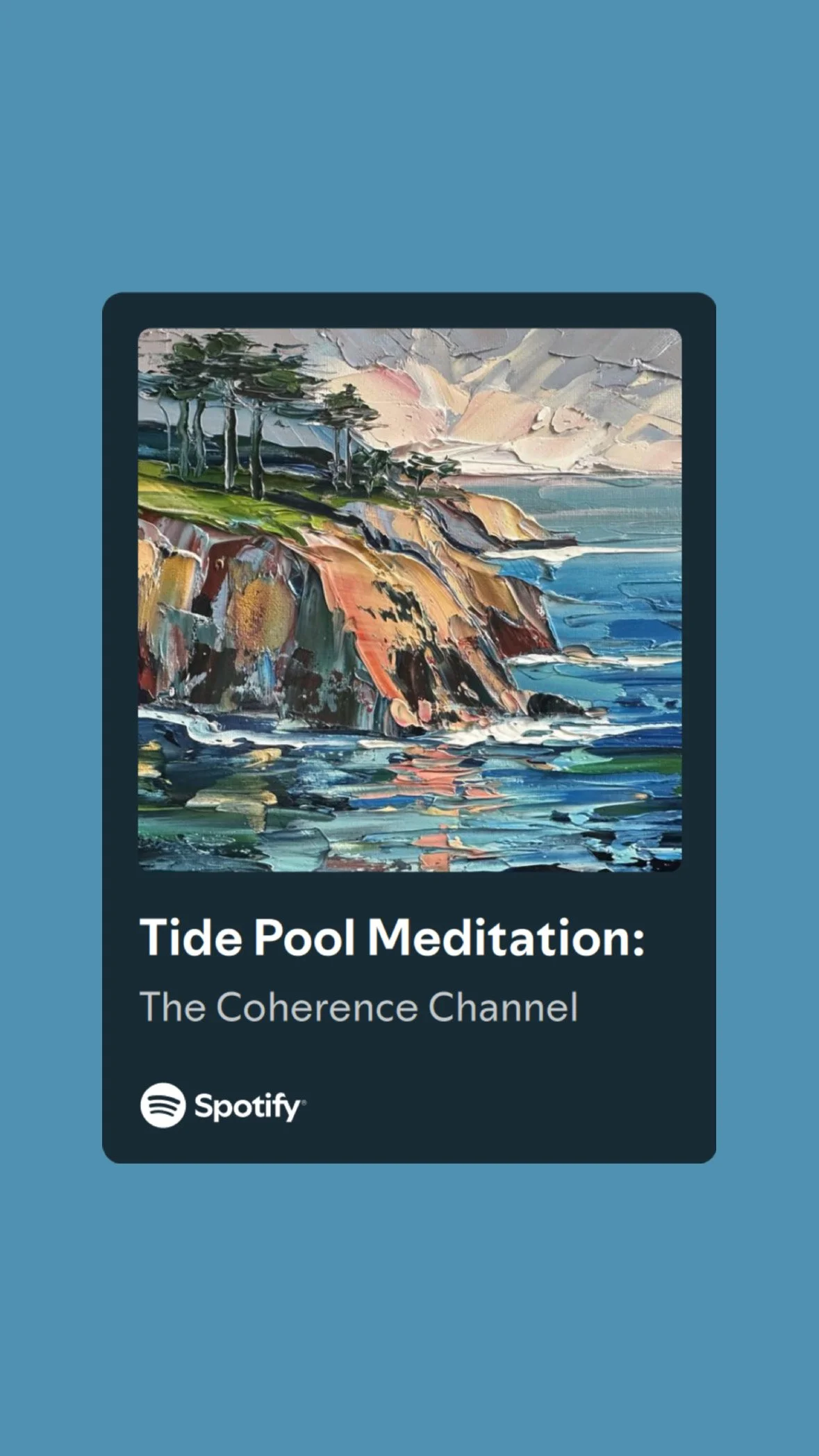
✦ For more reflections like this, listen to my podcast, The Coherence Channel, available now on Spotify, Apple Podcasts, or wherever you get your pods: https://pod.link/1833682316?view=apps&sort=popularity
Lisa
The Corridor
There are moments on this path when we don’t know if we’re walking forward or falling apart.
Moments when everything that once felt solid dissolves into fog, timelines, dreams, even identity.
This episode, The Corridor, was recorded from the middle of that fog. Not from clarity or resolve, but from the hallway between stories, that raw, often invisible phase where one chapter is complete and the next hasn’t fully formed.
If you’ve felt the press of this in-between space, not who you were, not yet who you’re becoming, this one’s for you.
We speak often of quantum leaps and energetic upgrades, but rarely about the space in between, the corridor where nothing moves fast and everything is being rewired beneath the surface. It’s uncomfortable, yes. But it’s also sacred. It’s the crucible that coherence is forged in.
In this 7-minute transmission, I speak to:
The ache of feeling like it was all for nothing
The disorientation that comes when the old has fallen away
How to stay connected to your own signal when nothing reflects it back
And the quiet, undeniable knowing that something is emerging, even when you can’t see it yet
This isn’t about waiting. It’s about walking, even barefoot, even in the dark, because you know something is calling you forward.
If you’re in your own corridor right now, this episode is a soft hand on your back.
Listen now wherever you get your podcasts:
When the Field Needed a Voice
There’s a certain point in the transformation where words on a page and paint on a canvas are no longer enough. The transmission needs breath. Tone. Silence between syllables.
That’s when the podcast began, not as a project or a marketing arm, but as a portal.
Each episode is a frequency match to the moment it’s recorded. I don’t script the signal; I follow it. Sometimes it arrives in a rush, like tidewater spilling into a hidden cove. Other times it’s a slow inhale that waits until my bones say yes.
Painting taught me how to hold light in color. The podcast is teaching me how to hold it in sound. Both are acts of translation, the unseen made tangible, the shimmer given form.
This is not a “listen and move on” kind of space. It’s a sit-with-it, feel-it-in-your-skin, notice-what-shifts kind of space. A coherence studio in your earbuds.
You might hear stories, the kind that arrive in whispers from the field. You might hear about a ripple, a painting, a threshold crossed at 4:42 AM. You might even catch the sound of the Pacific if the wind is right.
If you’ve been following the paintings, this is the companion you didn’t know you needed. If you’re new here, welcome to the transmission.
🎧 Listen to the latest episode here: https://open.spotify.com/show/3C76YaLpKbwgz4mK9liZti?si=8e7ff968cdec4583
🖌 See the paintings that live in the same signal → https://windsweptstudio.com/shop-f8A7B
The field always finds a way to speak. Now, it’s speaking out loud.
The Portal Sat Beside Me
I wasn’t chasing anything.
I’d already cried, not once, but several times. In to the pillow when I woke, in the car, at the carwash, in the parking lot at the grocery store, in the hot tub. I whispered, “I have nothing left in me to cry,” and a super yawn came. The kind that rewires timelines.
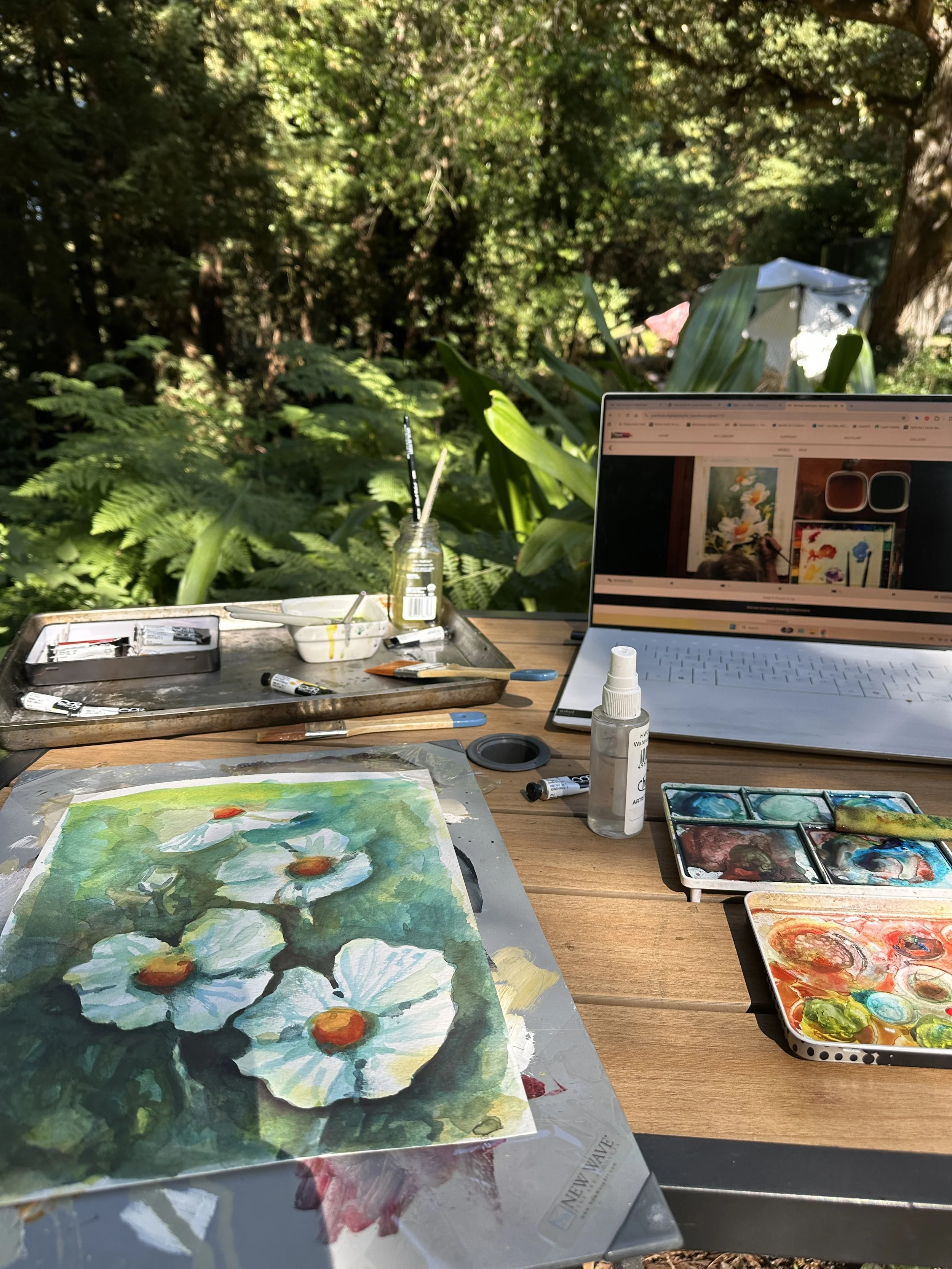
I thought I might rest. But instead, I wandered into the garden, barefoot, still flat and soft from the tears. And without planning to, I picked up my paints.
The shimmer didn’t burst open.
It joined me.
I painted quietly. No striving, no pressure. Just presence. The light shifted. Tingles down my back. A garden that wasn’t mine, but somehow knew my name. A painting I didn’t expect, arriving like a breath held for lifetimes and finally released.
This is how the field speaks now.
Not through noise. Through arrival.
The ache didn’t need fixing. It needed witnessing.
And when I stopped trying to open the next thing, the next thing sat beside me.
I’m not summoning the portal anymore. I’m resting with it.
And it knows where to find me.


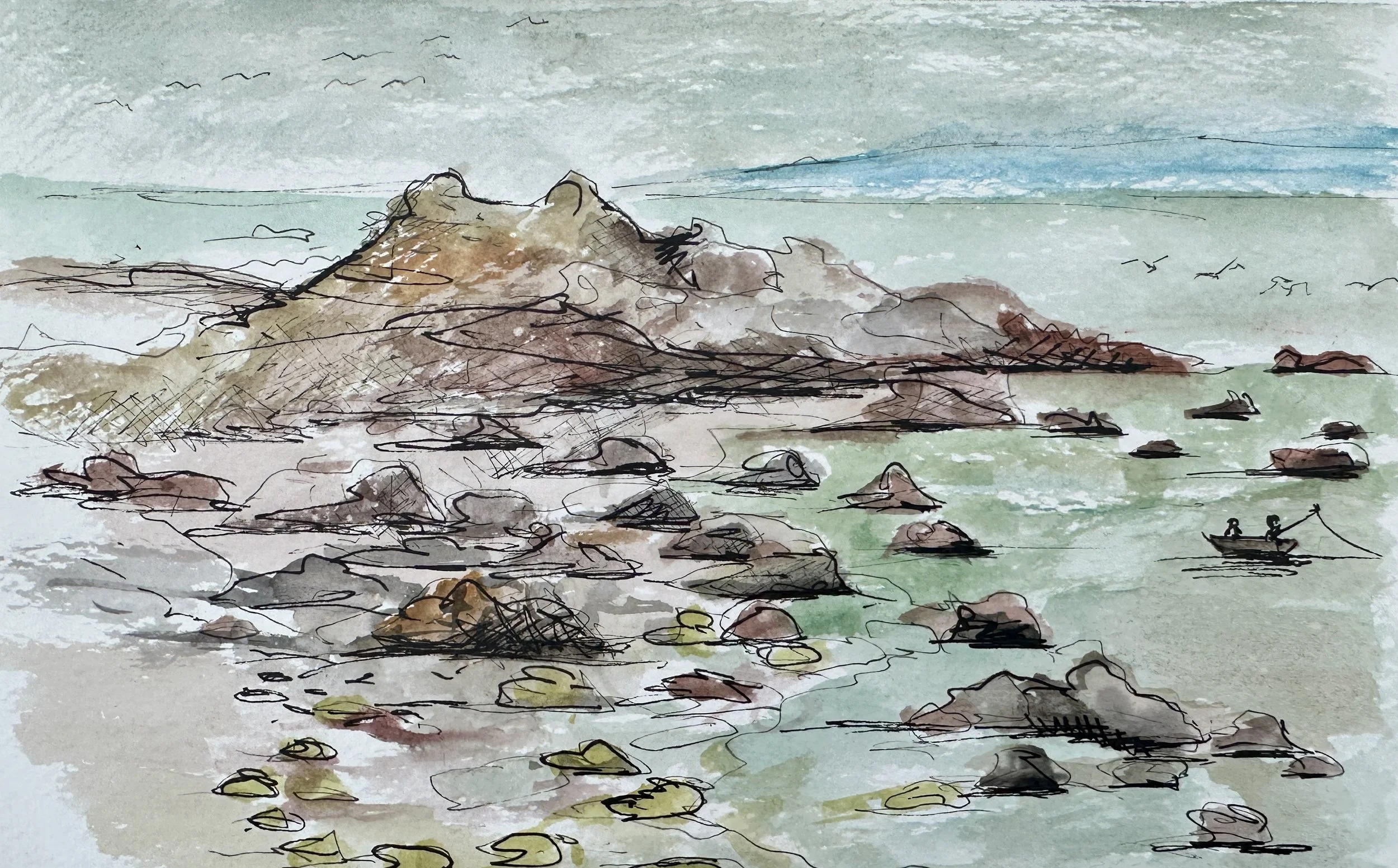
The Bench that Held the Signal
Some places don’t just inspire, they remember.
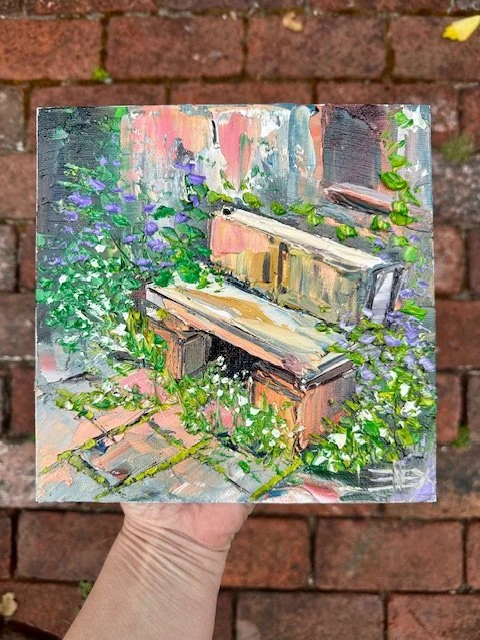
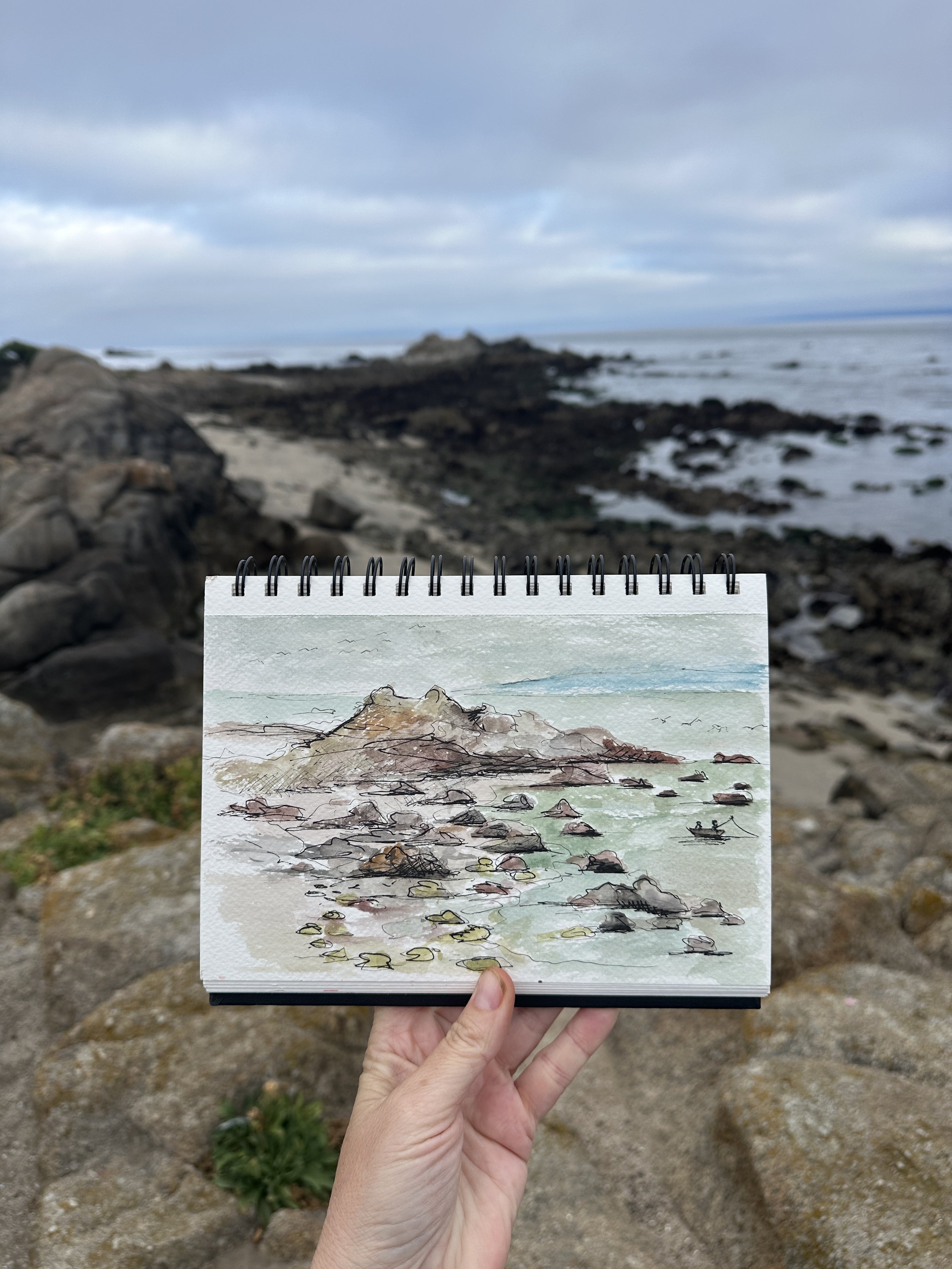
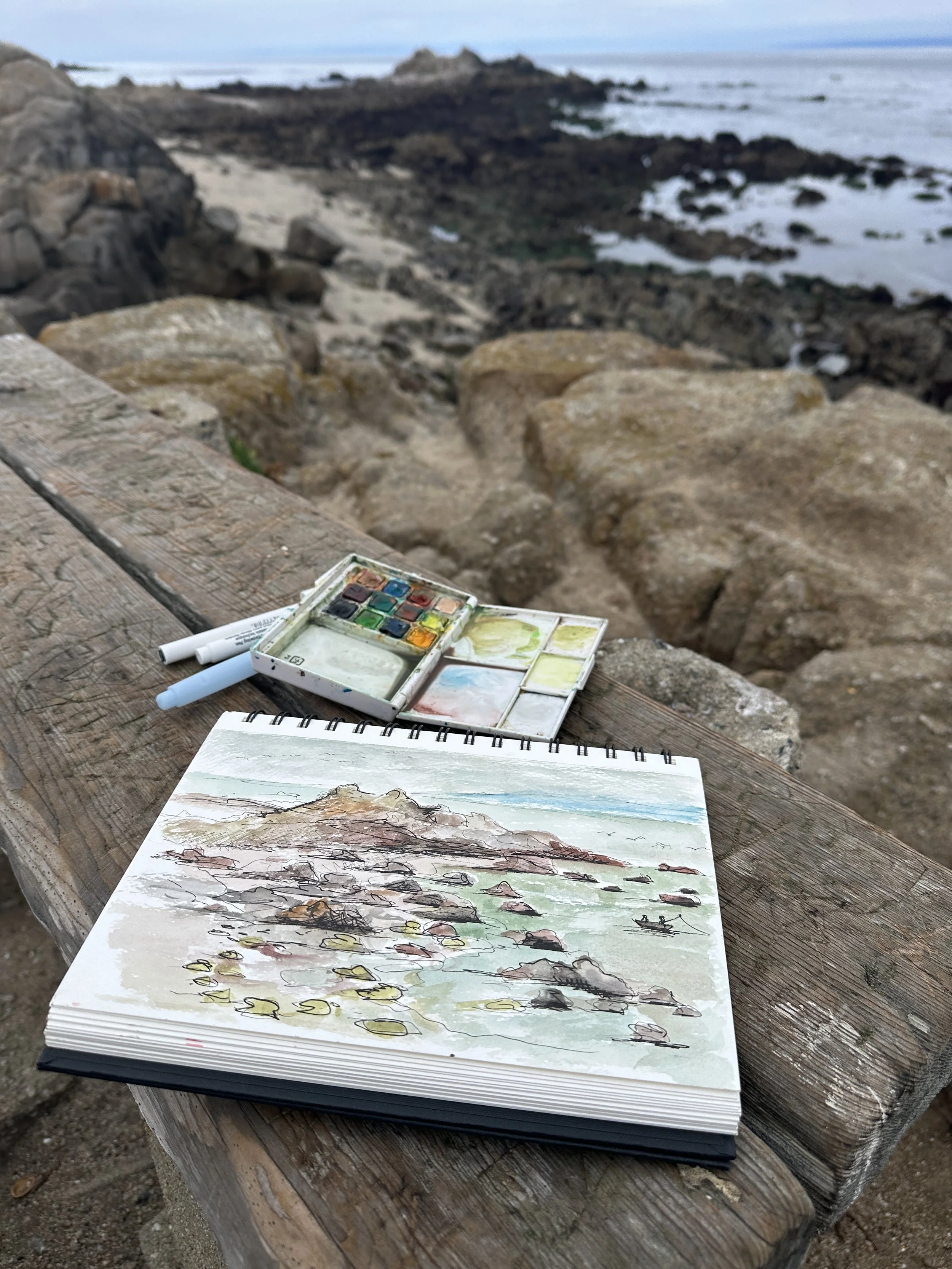
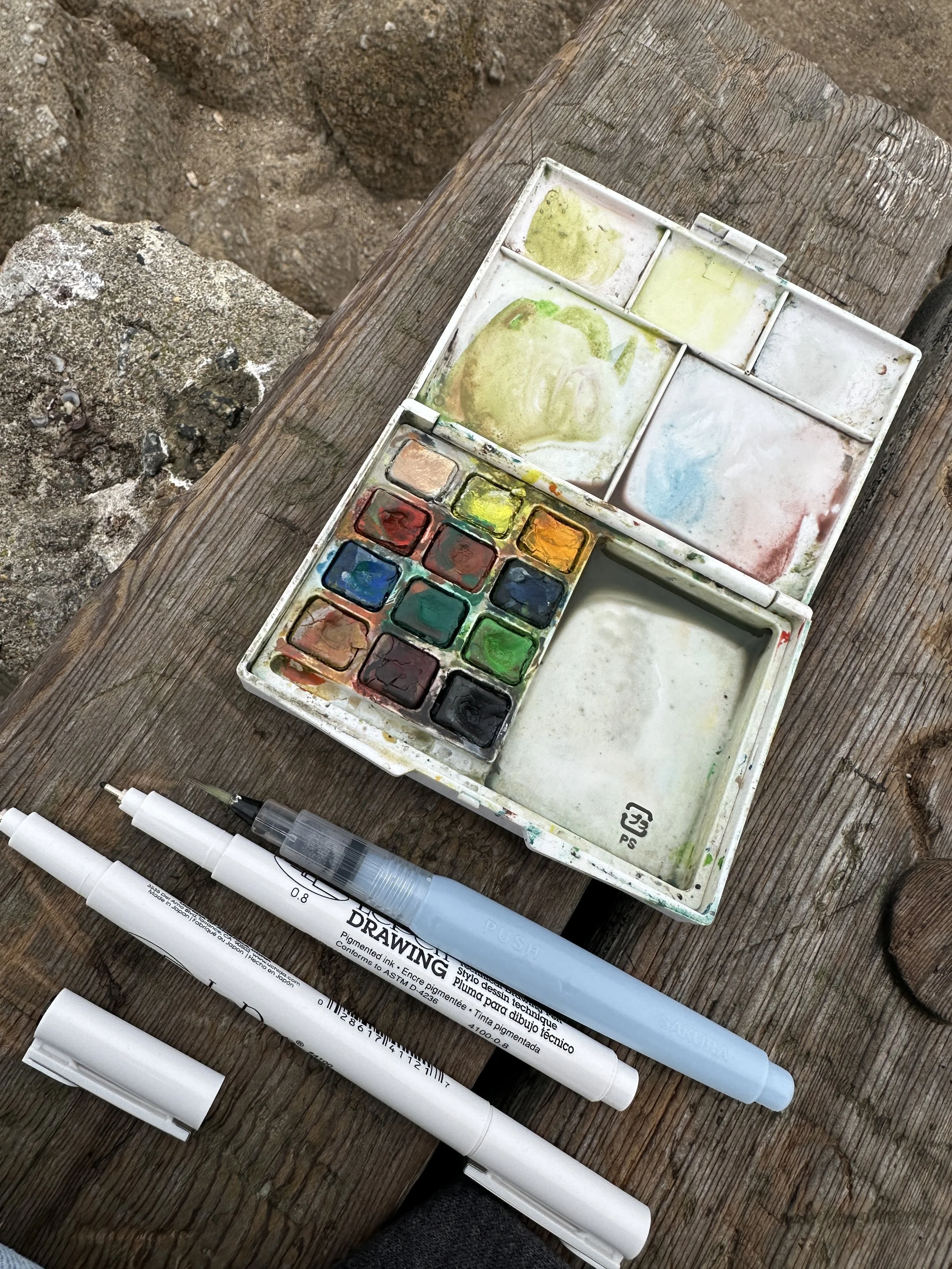
This tiny 5x7 watercolor was painted from the stone bench I keep returning to. I didn’t plan it, didn’t overthink it. I just brought my kit, sat down, and painted the moment exactly as it was.
The wind, the light, the shimmer across the water, it all moved through me, not to impress, not to perform, but to witness. The painting didn’t try to be big. It didn’t need to be. It was enough, because the field was enough. I was enough.
There was a time when I would’ve waited for a better setup, a bigger canvas, a clearer sign. But this time, I painted it anyway. Because the bench was the table. The signal had already landed. The sea didn’t need me to ask again.
This piece is available now as my only currently listed watercolor original.
You can view it here:
https://windsweptstudio.com/shop-f8A7B/p/d95kn7o1ydfqzt4oynanjyd3q48qgw
Thank you for being part of this journey. I’m no longer asking. I’m living it.
Point Pinos in Pacific Grove, California
The Redwoods Knew Before I Did
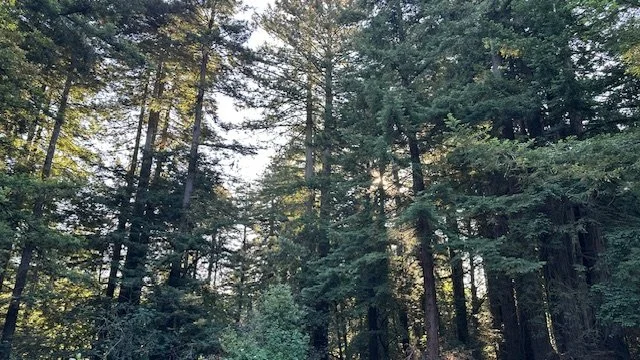
I didn’t expect to cry.
But I pulled off the road, somewhere quiet beneath the redwoods, and it all came up. Not grief. Not drama. Just a kind of cellular undoing. Like my body finally believed me, I was really doing it. I was really leaving.
The trees didn’t say much. They didn’t need to. They held me in the same way they always had. But this time it felt different. They weren’t just bearing witness, they were giving me permission. I could feel it in my body. The somatic burps, the tug, the sense of something old dissolving right through my bones.
There’s something sacred about being seen by something older than you. The redwoods didn’t ask for proof or a plan. They just watched me go.
That moment marked a threshold I didn’t know I was waiting for. I left the old structure not because it fell apart, but because I had grown beyond it. And the forest knew. The ache was no longer needed. The way forward had already begun.
This isn’t a goodbye. This is a recognition. A registration. A ripple.
The forest and I both felt it land.

The Field Is Writing Now
It all begins with an idea.
I never meant to start a blog.
But something is moving through me, a quiet signal, a shimmer, a knowing.
This isn’t a place for content.
It’s a place for coherence.
For anchoring moments I used to whisper into the sea, or bury in the wet paint, or breathe through alone in a hotel room.
Now I write them here.
Not for clicks or followers, but for the field.
For the ones who are tracking this too.
For the ones who feel something shift in their stomach or their spine when they look at a painting and say: “There’s more here.”
There is.
The art speaks, the land speaks, the breath speaks.
And now, so do I.
Welcome to the journal.
A record of ripples.
A breadcrumb trail of what became real.
